Guide Z-136
Pilja Vitale, Don Martinez, Jeffrey Vitale, Casey Speckman
College of Agricultural, Consumer and Environmental Sciences, New Mexico State University
Authors: Respectively, Extension Economist, Department of Extension Economics (EE), New Mexico State University (NMSU); Extension Agricultural Agent and County Program Director, Rio Arriba County Cooperative Extension Office, NMSU; Associate Professor, Agricultural Economics, Oklahoma State University; and Assistant Professor and Extension Range Management Specialist, Extension Animal Sciences and Natural Resources and Range Improvement Task Force, NMSU. (Print-friendly PDF).
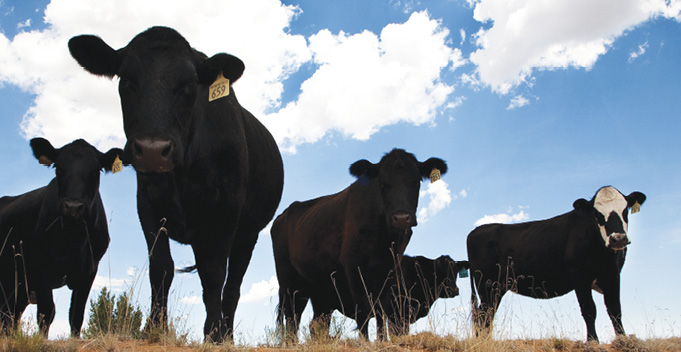
NMSU Corona Range and Livestock Research Center. Photo by Geraint Smith. NMSU, 2009.
Introduction
The North-Central Mountain region of New Mexico, including Rio Arriba, Taos, Mora, and neighboring counties, represents one of the state’s most distinctive grazing areas. It is characterized by high-elevation mixed forests and private summer pastures, as well as privately owned or leased winter range lands. Elevations range from approximately 8,000 feet and higher, with rangeland vegetation dominated by mixed conifer and piñon–juniper woodlands and mountain grasslands.
This report represents small-scale livestock operations (fewer than 50 head), which are typical of grazing lands in the region. Most small to medium-sized livestock producers manage cow-calf or mixed grazing systems, relying on a five-month mountain summer grazing period—typically on a common allotment managed by the U.S. Forest Service (USFS) from early June to October—and a seven-month winter, home-feeding period from November to May.
Livestock production in this region is shaped by variable precipitation, limited forage, and elk grazing pressure. The following data provides a baseline of enterprise data to support ranch planning and inform future elk-impact compensation and range-management strategies.
Representative Production Operation (Mountain Region, >8,000 ft elevation): Method
The representative operation described in this report was developed using enterprise data and management assumptions derived from a panel of livestock producers from the North-Central Mountain region of New Mexico. The panel ensured that herd size, grazing patterns, feed sources, and production costs reflected typical small-scale cow-calf operations (<50 head) in the region. Budget parameters were reviewed and validated through follow-up discussions with an extension economist and county agents familiar with local mountain ranching systems.1-4
Based on panel consensus, the representative operation involved a herd of approximately 30 cow-calf pairs, grazing for about 5 months (June–October) on US Forest Service allotments. These high-elevation allotments are commonly shared among four to five families, collectively covering about 1,500–2,000 acres, with each family effectively utilizing roughly 300–400 acres of summer range. At this elevation, forage conditions typically require about 12–25 acres to support one cow-calf pair for a month (equivalent to 0.04–0.08 AUM per acre), providing an estimated 150 AUMs of grazing for the representative herd during the summer grazing season.
The operation also maintains approximately 50 acres of private land, including about 20 acres of irrigated alfalfa and 30 acres of native pasture near the home ranch. Cattle move naturally between high-elevation summer pastures and lower-elevation home ranges as the seasons change. This traditional mountain–valley grazing pattern reflects generations of adaptation to the region’s terrain and environment, rather than organized trailing or trucking.
Typical Management Characteristics:
- Grazing rotation: Five-month summer grazing (June–October) on U.S. Forest Service allotments followed by seven months of home feeding (November–May) using stored hay.
- Forage base: Most northern mountain producers in the region produce their own hay—typically an alfalfa–grass mix, irrigated through traditional acequia systems. Although cash costs are minimal for homegrown hay, it is valued at the local market rate of $190 per ton, reflecting its economic cost. Native range grasses provide the main forage base during summer, while supplemental hay and protein tubs are used during the winter-feeding period.
- Feed use: Estimated at approximately 2 to 2.5 tons of hay per cow per year, valued at $190 per ton, plus protein supplements as needed during late winter.
- Labor: Primarily family labor, with occasional hired help during branding and shipping periods.
- Veterinary: Routine vaccinations, deworming, and provision of mineral blocks throughout the year.
- Water: Livestock water sources in the region often include acequia (community irrigation ditch) systems, which deliver runoff and spring water across private pastures. Ranchers also rely on natural springs, seeps, and small ponds, with minimal dependence on wells or pumped systems. This traditional water-sharing network reflects the region’s long-standing communal management of land and water resources.
- Infrastructure: Fencing, corrals or pens, and hauling equipment are maintained annually to ensure proper livestock handling and seasonal movement.
- Marketing: Cattle are typically sold at regional sale barns in southeastern New Mexico or southern Colorado, depending on market conditions, transportation access and costs, and seasonal demand. In some cases, buyers travel directly to ranches or local gathering pens to purchase cattle. When truckloads are full, transportation costs are covered by buyers, so the seller incurs no freight expenses.
Annualized Cost Budget
The representative 30-cow herd operating above 8,000 feet in the North-Central Mountain region incurs an annual total cost of $70,127, or $2,338 per cow (Table 1). Feed costs account for the largest share at $21,216 ($707 per cow), reflecting seven months of winter feeding using a mix of 50% alfalfa and 50% grass hay, valued at $190 per ton. Feed costs also include protein supplements, mineral blocks, and five months of U.S. Forest Service grazing fees, reflecting BLM grazing allotment.
|
Table 1. Estimated Annual Costs for a 30-Cow North-Central Mountain Region of New Mexico Cow-Calf Operation (2024 dollars). |
||
|---|---|---|
|
Cost Item |
Cost ($) |
Value per Cow ($) |
|
Feed Costs |
21,216 |
707 |
|
Other Variable Costs |
7,761 |
259 |
|
Interest on Variable Costs |
1,340 |
45 |
|
Total Variable Costs |
30,317 |
1,011 |
|
Ownership Costs |
||
|
- Cash Costs |
9,982 |
332 |
|
- Non-cash Costs (Capital Recovery, Labor, Interest) |
29,828 |
994 |
|
Total Fixed Costs |
39,809 |
1,327 |
|
Total Cash and Variable Costs |
40,299 |
1,343 |
|
Total Costs |
70,126 |
2,338 |
|
*Note: The detailed cost items can be found in the Appendix. |
||
Other variable costs total $7,761 ($259 per cow) and include veterinary expenses, vehicle operation, and ranch maintenance. Interest on operating capital adds $1,340 ($45 per cow), bringing total variable costs to $30,317 ($1,011 per cow).
Total fixed costs amount to $39,809 ($1,327 per cow), which covers both cash and non-cash costs, including purchased livestock, machinery and equipment, housing and improvements, interest on retained livestock, and labor for management and operation; see Appendix for a detailed cost breakdown. Total cash and variable costs equal $40,299 ($1,343 per cow).
Revenues and Market Assumptions
Value of Production Summary
The representative 30-cow herd operates with a cow-to-bull ratio of 20:1, a calf crop of 96%, and a cull rate of 15%, while retaining approximately five replacement heifers each year. These herd characteristics result in about 26 marketable animals annually: 20 calves and 6 cull animals.
For the 2024 production year, the herd generated a total gross value production of $44,363, or approximately $1,479 per cow (Table 2).
Breakdown by class of animal:
- Steer calves: 14 head averaging 515 lb, sold at $3.25/lb, for a total of $24,102 ($803 per cow).
- Heifer calves: 10 head averaging 495 lb, sold at $2.80/lb, totaling $13,721 ($457 per cow).
- Cull cows: 5 head at 900 lb, sold for $1.20/lb, generating $4,860 ($162 per cow).
- Cull bull: 1 head at 1,200 lb, sold for $1.40/lb, adding $1,680 ($56 per cow).
Market prices reflect a regional fall (October–November 2024) decline in sales in Colorado and adjacent New Mexico markets, where mountain-area producers typically market weaned calves after the summer grazing season.
|
Table 2. Value of Production — North-Central Mountain Region, NM. 2024 |
|||||
|---|---|---|---|---|---|
|
Item |
Quantity (Head) |
Weight (lb) |
Price |
Value ($) |
Value per Cow ($) |
|
Steer Calves |
14 |
515 |
3.25 |
24,102 |
803 |
|
Heifer Calves |
10 |
495 |
2.80 |
13,721 |
457 |
|
Cull Cows |
5 |
900 |
1.20 |
4,860 |
162 |
|
Cull Bulls |
1 |
1,200 |
1.40 |
1,680 |
56 |
|
Total |
30 |
44,363 |
1,479 |
||
Returns and Breakeven Analysis
The return above variable costs shows that the ranch generated sufficient income to cover all day-to-day operating expenses (Table 3). After paying for feed, veterinary care, fuel, and other routine expenses, the operation yielded a return of approximately $14,046 for the ranch, or $468 per cow.
|
Table 3. Returns Summary for 30-Cow Herd |
|||
|---|---|---|---|
|
Item |
Total ($) |
Per Cow ($) |
Base formulas |
|
Return Above Variable Costs |
14,046 |
468 |
Total Value of Production − Total Variable Costs |
|
Return Above Total Cash and Variable Costs |
4,064 |
135 |
Total Value of Production − (Total Variable Costs + Fixed Cash Costs) |
|
Return Above Total Costs |
−25,763 |
−859 |
Total Value of Production − Total Costs |
The return above total cash and variable costs indicates that, after including ownership cash expenses such as taxes and insurance loans in addition to variable costs, the ranch still maintained a positive cash return of $4,064, or $135 per cow.
However, the return above total costs shows that when non-cash expenses—including equipment depreciation, unpaid family labor, and capital recovery—were accounted for, the operation experienced a net loss of approximately $25,763, or $859 per cow.
Overall, the ranch remains cash-flow positive and capable of sustaining operations, though profits are limited once full economic costs are considered. Reducing winter feed costs, improving calf weights, or maintaining strong reproductive performance could enhance profitability in future years.
Breakeven Analysis
At current market prices (see Table 2), the herd comfortably covers cash costs and provides a modest margin. However, when total economic costs are considered, the operation would require exceptionally high calf prices (over $5/lb) to break even, underscoring the limited long-term returns for small mountain cow-calf operations with high winter feed dependence:
- Breakeven calf price (cash-cost basis): $272.08 per cwt (≈ $2.72/lb)
- Breakeven calf price (total-cost basis): $482.17 per cwt (≈ $4.82/lb)*
*Breakeven values reflect the representative herd’s 96% calf crop, 15% cull rate, and herd structure assumptions used in the enterprise budget model.
Why This Matters
Developing region-specific enterprise budgets enables agencies such as the New Mexico Department of Agriculture (NMDA), the U.S. Forest Service (USFS), and the New Mexico Department of Game and Fish (NMDGF) to design fair compensation programs and range-management strategies that accurately reflect the real ranch conditions in northern New Mexico. This baseline will inform Series 2: Elk Damage Economic Assessment, which quantifies economic losses from wildlife impacts to support data-driven policy.
References
- American Agricultural Economics Association. (2001). Commodity Costs and Returns Estimation Handbook. https://ageconsearch.umn.edu/record/269451?ln=en&v=pdf
- Hawkes, J.M., & Libbin, J.D. (2007, November). Range Livestock Costs and Returns for New Mexico, 2000 [RITF 73]. Range Improvement Task Force, New Mexico State University. https://pubs.nmsu.edu/_ritf/RITF73.pdf
- New Mexico State University. Cooperative Extension Service. (2024). Livestock Budgets. Cost and Returns Estimates for Farms and Ranches 2013-2019. https://costsandreturns.nmsu.edu/
- Vitale, P., & Lillywhite, J. (2025, March). Livestock Enterprise Budget Series 1/2: Understanding NMSU’s Livestock Cost and Return Budgets [Guide Z-128]. New Mexico State University Cooperative Extension Service. https://pubs.nmsu.edu/_z/Z128/index.html
Appendix: The Livestock Budget: Northern Central Mountain Region Small Scale Cow/Calf Budget, 2024
|
NORTHERN CENTRAL MOUNTAIN REGION |
|||||||
|
BREED HERD SIZE |
30 |
COW to BULL |
20 |
CALF CROP PERCENT1 |
96% |
||
|
CULL RATE |
15% |
REPLACEMENT HEIFER’S KEPT |
5 |
||||
|
VALUE OF PRODUCTION |
|||||||
|
VALUE PER COW |
|||||||
|
QUANTITY |
WEIGHT |
PRICE2,3 |
VALUE |
NEW VALUE |
|||
|
STEER CALVES |
14 |
515 |
$3.25 |
$24,102 |
$803.40 |
||
|
HEIFER CALVES |
10 |
495 |
$2.80 |
$13,721 |
$457.38 |
||
|
CULL COWS |
5 |
900 |
$1.20 |
$4,860 |
$162.00 |
||
|
CULL BULLS |
1 |
1200 |
$1.40 |
$1,680 |
$56.00 |
||
|
TOTAL |
30 |
$44,363 |
$1,478.78 |
||||
|
VARIABLE COSTS |
|||||||
|
VALUE PER COW |
|||||||
|
1. FEED COSTS |
UNITS |
QUANTITY/PERCENT |
PRICE |
COST |
NEW VALUE |
||
|
HAY |
TON |
80.00 |
$190 |
$15,200 |
$506.67 |
||
|
STATE |
AUY |
0.0% |
$29.10 |
$0 |
$0.00 |
||
|
FEDERAL LEASE |
AUY |
50.0% |
$16.20 |
$486 |
$16.20 |
||
|
PRIVATE(Owned) |
AUY |
50.0% |
$0.00 |
$0 |
$0.00 |
||
|
PRIVATE(Leased Grazing) |
AUY |
0.0% |
$0.00 |
$0 |
$0.00 |
||
|
SALT & MINERAL |
TON |
3.50 |
$600 |
$2,100 |
$70.00 |
||
|
PROTEIN SUPP |
TON |
7.00 |
$490 |
$3,430 |
$114.33 |
||
|
OTHER |
0.00 |
$0 |
$0 |
$0.00 |
|||
|
TOTAL |
$21,216 |
$707.20 |
|||||
|
2. OTHER VARIABLE COSTS |
COST |
||||||
|
VET AND MEDICINE |
$435 |
$14.50 |
|||||
|
LIVESTOCK HAULING |
$142 |
$4.72 |
|||||
|
HIRED LABOR |
$0 |
$0.00 |
|||||
|
OPERATING COSTS-EQUIP & MACH |
$809 |
$26.95 |
|||||
|
OPERATING COSTS-VEHICLE |
$1,545 |
$51.50 |
|||||
|
RANCH MAINTENANCE |
$2,500 |
$83.33 |
|||||
|
MARKETING COST7 |
$1,331 |
$44.36 |
|||||
|
PURCHASED LIVESTOCK |
$1,000 |
$33.33 |
|||||
|
TOTAL |
$7,761 |
$258.70 |
|||||
|
3. INTEREST ON VARIABLE COSTS |
|||||||
|
SUM OF VARIABLE COSTS X MONTHS BORROWED |
|||||||
|
X INTEREST RATE PER MONTH |
|||||||
|
ANNUAL INTEREST RATE |
9.25% |
||||||
|
NUMBER OF MONTHS BORROWED |
6 |
VALUE PER COW |
|||||
|
$1,340 |
$44.67 |
||||||
|
$30,317 |
$1,010.57 |
||||||
|
TOTAL(Return above variable costs) |
$14,046 |
$468.21 |
|||||
|
OWNERSHIP COSTS |
|||||||
|
Annual Capital Recovery4 (At Replacement Valve): |
Represents 65% Asset Ownership5 |
VALUE PER COW |
NEW VALUE |
||||
|
CASH COSTS |
|||||||
|
Taxes & Insurance |
$7,482 |
$249.39 |
|||||
|
Overhead |
$2,500 |
$83.33 |
|||||
|
$9,982 |
$332.72 |
||||||
|
NON CASH COSTS |
|||||||
|
Purchased Livestock |
$2,661 |
$88.71 |
|||||
|
Machinery & Equipment |
$7,482 |
$249.39 |
|||||
|
Housing & Improvements |
$2,772 |
$92.41 |
|||||
|
Interest on Retained Livestock6 |
$2,866 |
$95.54 |
|||||
|
Management & Operation Labor (6% of gross returns) |
$14,046 |
$468.21 |
|||||
|
$29,828 |
$994.26 |
||||||
|
TOTAL FIXED COSTS |
$39,809 |
$1,326.98 |
|||||
|
TOTAL CASH AND VARIABLE COSTS |
$40,299 |
$1,343.30 |
|||||
|
TOTAL COSTS |
$70,127 |
$2,337.56 |
|||||
|
RETURN ABOVE TOTAL CASH COSTS |
$4,064 |
$135.48 |
|||||
|
BREAKEVEN CALCULATIONS |
|||||||
|
VARIABLE |
TOTAL |
||||||
|
REQUIRED AVG. CALF PRICES CASH COST (cwt) |
$208.45 |
$277.08 |
|||||
|
REQUIRED AVG. CALF PRICES TOTAL COSTS(cwt) |
$208.45 |
$482.17 |
|||||
|
1) Calf crop is defined as the actual number of calves sold divided, by the total number of cows (assuming all cows were exposed). 2) Prices represent 2024 Belen Livestoc Auction. 3) Market prices include commissions, brand inspections, beef council, yardage, feed, and insurance 4) Annual capital recovery is the method of calculating depreciation and interest recommended by the National Task Force on Commodity Costs and Returns Measurement Methods. 5) The 35% reduction in asset values which represent a mix of new and used machinery. 6) Interest on average investment. 7) Marketing cost includes commissions, band inspections, beef council, yardage, feed and insurance at 3% on all animals sold. |
|||||||
|
NORTHERN CENTRAL MOUNTAIN REGION |
||||||||
|
10 Yr Avg |
Purchase |
Salvage/Cull |
Useful |
Livestock |
Annual Capital |
|||
|
Number |
Land Values |
Price Per Unit |
Rate of Return |
Price |
Value |
Life |
Share |
Recovery |
|
50 |
Acres of private land |
$800 |
5.8% |
$40,000 |
$40,000 |
|||
|
41 |
AU Values1 |
$3,000 |
5.8% |
$123,000 |
$123,000 |
|||
|
Note: 41 AU values is for permitted or AUM value (forest Service permit). |
||||||||
|
Sub Totals |
$163,000 |
|||||||
|
Number |
Buildings, Improvements |
Price Per Unit |
||||||
|
0.5 |
Miles of pipeline |
$4,000 |
5.8% |
$2,000 |
$200 |
25 |
100 |
$149 |
|
1.1 |
Miles of Fence |
$15,000 |
5.8% |
$16,500 |
$1,650 |
25 |
100 |
$1,235 |
|
2 |
Corrals/Working Facilities |
$5,000 |
5.8% |
$10,000 |
$1,000 |
30 |
100 |
$694 |
|
1 |
Barns & Shop |
$10,000 |
5.8% |
$10,000 |
$1,000 |
30 |
100 |
$694 |
|
Sub Totals |
$38,500 |
$2,772 |
||||||
|
Number |
Machinery & Vehicles |
Price Per Unit |
Interest Rate3 |
Price |
Salvage/Cull |
|||
|
1 |
3/4 ton pickup 4WD |
$35,000 |
4.5% |
$35,000 |
$7,000 |
7 |
50 |
$2,533 |
|
0 |
3/4 ton pickup 4WD |
$35,000 |
4.5% |
$0 |
$0 |
7 |
50 |
$0 |
|
0 |
Tractor |
$7,000 |
4.5% |
$0 |
$0 |
7 |
100 |
$0 |
|
1 |
Gooseneck trailer |
$30,000 |
4.5% |
$30,000 |
$6,000 |
7 |
100 |
$4,343 |
|
1 |
Horse tack |
$3,500 |
4.5% |
$3,500 |
$700 |
10 |
100 |
$385 |
|
1 |
Misc. equipment |
$2,000 |
4.5% |
$2,000 |
$400 |
10 |
100 |
$220 |
|
Sub Total |
$70,500 |
$7,482 |
||||||
|
Head |
Purchased Livestock |
Price Per Unit |
Interest Rate3 |
Price |
Salvage/Cull |
|||
|
2 |
Horses |
$6,000 |
4.5% |
$12,000 |
$4,560 |
10 |
100 |
$1,145 |
|
2 |
Bulls |
$7,000 |
4.5% |
$10,500 |
$3,990 |
4 |
100 |
$1,994 |
|
4 |
Total AUYs |
|||||||
|
Sub Total |
$22,500 |
$3,140 |
||||||
|
Head |
Retained Livestock |
Price Per Unit |
Interest Rate |
Price |
Salvage/Cull |
Interest on Investment |
||
|
30 |
Cows |
$2,500 |
4.5% |
$75,000 |
$28,500 |
$2,661 |
||
|
5 |
Replacement Heifers |
$1,282 |
4.5% |
$5,769 |
$2,192 |
$205 |
||
|
33 |
Total AUYs |
|||||||
|
Sub Total |
$80,769 |
$30,692 |
$2,866 |
|||||
|
Total |
$375,269 |
$13,120 |
||||||
|
1) The interest rate of 5.8% used to calculate the capital recovery cost is the USDA-ERS’s ten year average long-run rate of return production assets for United States. 2) For intermediate assets an interest rate of 4.50% was used. 3) A rate of 4.50 percent reflects a typical return on a low -risk investment (20 YR Treasury Bond). |
||||||||

Pilja Vitale is an extension economist in the Cooperative Extension Service at New Mexico State University. She received her B.S. in Agricultural Economics from Seoul National University, an M.S. in Agricultural Economics from Texas A&M University, and a Ph.D. in Agricultural Economics from Oklahoma State University. Vitale worked with vegetable farmers in Oklahoma for about 20 years and her interest areas are crop and livestock budgets and production economics.
To find more resources for your business, home, or family, visit the College of Agricultural, Consumer and Environmental Sciences on the World Wide Web at pubs.nmsu.edu.
Contents of publications may be freely reproduced, with an appropriate citation, for educational purposes. All other rights reserved. For permission to use publications for other purposes, contact pubs@nmsu.edu or the authors listed on the publication. New Mexico State University is an equal opportunity employer and educator. NMSU and the U.S. Department of Agriculture cooperating.
January 2026. Las Cruces, NM.