Guide B-137
Caleb B. Hubbard, Marcy Ward, Brandon G. Smythe
College of Agricultural, Consumer and Environmental Sciences
Authors: Respectively, Assistant Professor, Department of Entomology, Plant Pathology and Weed Science; Extension Livestock Specialist, Department of Extension Animal Sciences and Natural Resources; and Research Assistant Professor, Department of Animal and Range Sciences. All from New Mexico State University. (Print Friendly PDF)
Introduction
The New World screwworm (NWS), Cochliomyia hominivorax (Coquerel, 1858), is an obligate parasite of warm-blooded animals and is one of the most destructive ectoparasitic pests of livestock in the Americas. Before its eradication from the United States, NWS cost U.S. livestock producers hundreds of millions of dollars annually; USDA estimated the benefit of eradication to the U.S. livestock industry at approximately $796 million per year by 1996, and the fly continues to cause substantial losses across Central and South America where it remains established. Damage of NWS is due to disruption of livestock production and exports, increasing animal morbidity/mortality, reducing production, and increasing veterinary cost. This species likely also causes unquantifiable, significant harm to wildlife. Unlike most blow flies, NWS causes damage because of its ability to cause “primary myiasis”, the infestation of the living tissue of a vertebrate host by fly larvae. In primary myiasis, larvae initiate the infestation by feeding on healthy living tissue, whereas in secondary (facultative) myiasis larvae feed on dead or decaying tissue within a wound that already exists. NWS infestation can result in rapidly expanding wounds, severe animal stress, and potentially death if untreated. Myiasis causes both direct damage to warm-blooded host animals (through feeding) and indirect damage resulting from secondary bacterial infections.
The significant economic and ecological consequences of NWS in the Americas led to the development of the sterile insect technique.1,2 With this method, NWS was successfully eradicated from the United States by 1966.3 In this approach, mass-reared flies are sterilized by irradiation and released in large numbers to mate with wild females, which then produce no viable offspring as NWS females typically mate only once in their lifetime, so a single mating with a sterile male eliminates her entire ability to produce viable offspring. Despite this development, outbreaks persisted through the early 1980s due to introductions from Mexico and some Caribbean Islands.4 By the early 2000s, NWS had been successfully pushed south to the Panama-Colombia border, where a quarantine zone was established to prevent flies from moving north of Panama. In 2023, NWS surpassed a barrier established between the Colombia and Panama border and spread from Central America to Mexico, posing a threat to the livestock industry in the United States.5 Between November 2024 and February 2026, a total of 15,376 confirmed cases of NWS infestations were documented in Mexico alone, with that number doubling by August 2026 (> 36,000 cases, 10 Aug 2026). As of November 2025, NWS had been detected more than once in cattle in Nuevo León, Mexico, less than 100 km from the Texas border, and a human case was imported into Maryland after travel to El Salvador. On June 3, 2026, USDA-APHIS confirmed the first NWS detection in the United States since eradication, in a three-week-old calf in Zavala County, Texas. Additional detections followed within days, including cases in La Salle and Andrews counties, Texas, and a dog in Lea County, New Mexico, on June 8, 2026. In response, USDA activated the sterile fly dispersal facility at Moore Air Base in Edinburg, Texas, and began aerial release. As of 27 Oct 2026, there have been 66 total cases of NWS in Texas and New Mexico, with 14 new myiasis cases in the last month. Because this situation continues to change rapidly, readers should consult USDA-APHIS and the New Mexico Department of Agriculture for the most current case information.
Identification
Generalized descriptions of NWS are listed below. For a more in-depth description of the characteristics used to identify adult NWS, please see Adult New World Screwworm Identification and Commonly Confused Species (Guide A-156).6 However, it is important to note that many visual characteristics can vary (coloration of the fly, for example), making proper identification and separation from closely related fly species challenging. Any suspect flies should always be reported to the proper agency, as listed below.
In New Mexico:
- For all domestic animals: New Mexico Livestock Board-505-841-6161 (front desk)
- For wildlife: New Mexico Department of Wildlife: (888) 248-6866 or ispa@dgf.nm.gov
- For public health: New Mexico Department of Health Hotline (833-796-8773)
- After hours, call the AgroGuard Hotline (1-800-525-2782) or fill out NMDA’s reporting form (QR code or visit https://tinyurl.com/NWSReporting)
Sample collection kits are available at your local NMSU Cooperative Extension Office. Each kit contains a vial of preservative, labels, and instructions for collecting and submitting suspect larvae for identification. If a kit is not available at the time a sample is collected, record the animal species affected, describe the wound or infestation, and, when possible, preserve specimens in 70% isopropyl alcohol for laboratory confirmation.

Adult New World Screwworm Fly
Adult flies are typically the size of a house fly or slightly larger but have a metallic blue-green color with large orange/red eyes (Figure 1) and three distinct stripes that run down the back of the fly just behind the head. While other similar-looking blow flies also have three stripes, in NWS the middle stripe is shorter and does not extend as far forward as the left and right stripes (Figure 2), whereas in other closely related species, all three stripes begin at the same point behind the head (Figure 3). Larvae of these closely related species feed on dead or decaying tissue rather than on healthy living tissue; although they are sometimes recovered from wounds on living animals, they do not cause the primary myiasis that makes NWS so damaging.
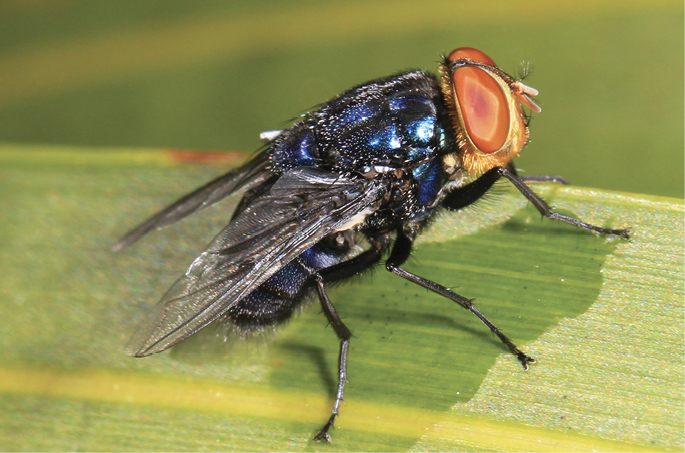
Figure 1. Adult New World Screwworm Fly (NWS) with characteristic large orange/red eyes and metallic colored body. Photo by Judy Gallagher.
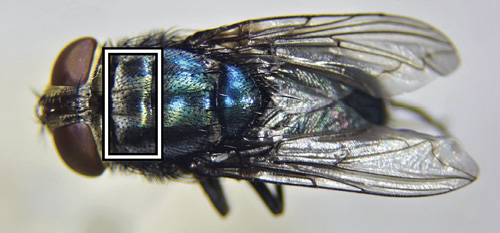
Figure 2. Adult New World Screwworm Fly showing the three characteristic stripes on its back (dorsum). Note that the middle black stripe usually is shorter and begins farther from the head than the outer two stripes. Photo courtesy of Sohath Zamira Yusseff-Vanegas.
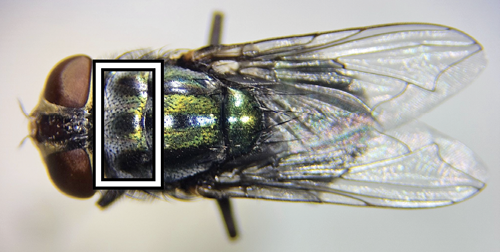
Figure 3. Adult of a closely related blow fly, with three characteristic stripes on its back (dorsum). Note that all three black stripes begin at the same distance from the head. Photo courtesy of Sohath Zamira Yusseff-Vanegas.
In nature, adult NWS are usually present in low numbers, and most animal owners are not likely to observe these flies often, even in actively infested areas. Rather than being evenly distributed across a landscape, adults tend to rest in shaded vegetation near host animals; this behavior is why USDA surveillance traps baited with swormlure are placed in vegetated areas a short distance from livestock. Adults are active during daylight hours and are most active at temperatures between 68°F and 91°F (20–33°C), with activity dropping sharply below 68°F (20°C). Under field conditions, adults generally live about two to three weeks, although survival can be longer under cool, humid conditions.
Female flies lay eggs in clumps (Figure 4) on the edge of open wounds or openings of an animal’s body (mucosal membrane). NWS tend to target ears, navels, castration sites, cuts, dehorning sites, cattle grub holes, and even tick bites. A female can lay 100 to 300 eggs in a single mass and, because she can produce a new egg mass every few days, may deposit up to approximately 3,000 eggs over her lifetime.
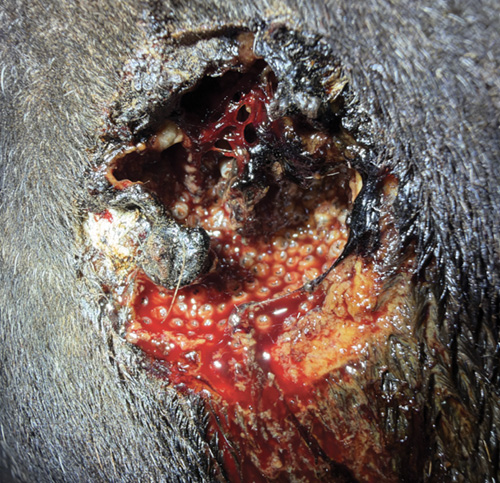
Figure 4. New World screwworm egg masses on an open wound. Photo courtesy of Alexis N. Olmos.
Larvae (Maggots)
NWS larval stages are responsible for most of the injury and economic loss associated with this fly species. Active infestations with NWS larvae produce a foul-smelling wound that attracts female screwworms to lay additional eggs.
Screwworm larvae are the most easily observable life stage of this parasite. Larvae will be visible in wounds within 3 days of eggs being deposited by the adult female fly (Figure 4). Larvae are whitish in color and have rings of dark spines that encircle the body at each body segment (Figure 5). Mature larvae can reach 17 mm in length (roughly 2/3 inch). The name screwworm refers to the feeding behavior of the maggots as they burrow into the flesh of the host, as well as to the rings of spines around the body, which give the larvae the appearance of a screw (Figure 5). Screwworm larvae use their mouth hooks to burrow into the flesh. Official identification of larvae relies largely on diagnostic features, including the presence of dual internal breathing tubes (Figure 6), and on genetic confirmation performed by USDA-APHIS; identification should always be made by a trained professional. Screwworm larvae develop through three distinct phases (L1, L2, and L3), feeding on living tissue for 5-7 days before late-stage larvae (L3) migrate out of the active wound site and drop to the ground, where they burrow into the soil and pupate.
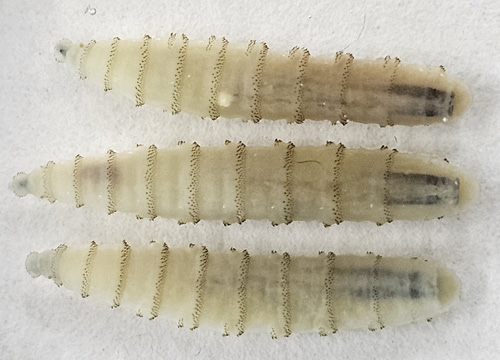
Figure 5. Close-up photo of a New World Screwworm Fly larvae showing the dual internal breathing tubes used for official identification (dark structures at the posterior end; right side of larva), as well as the rings of spines encircling each body segment. Photo courtesy of Sohath Zamira Yusseff-Vanegas, USDA ARS.
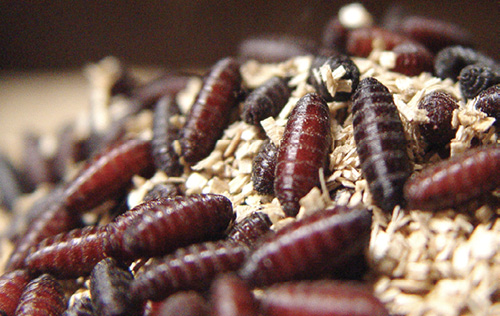
Figure 6. Close-up photo of New World screwworm pupae with characteristic dark brown appearance. These pupae are from the Panama – United States Commission for the Eradication and Prevention of Screwworm (COPEG) facility in Panama. In the field, pupal densities are much lower, and pupae are generally found individually in the soil. Photo courtesy of USDA.
Pupae
New World screwworm pupae, like most fly pupae, are characterized by their elongated, brownish protective casing that allows for the initiation, finalization, and emergence of new flies to the adult fly stage. Although immobile, this life stage is critical to sustaining populations of screwworms. The length of the pupal stage is strongly temperature dependent: adults may emerge in as few as 7 days under warm conditions (near 85°F/29°C), but the pupal period can extend to 54 days or longer during cool weather.7,8 L3 larvae migration is of particular concern during shipment of infested animals which can help spread and establish populations along common animal trade routes. Furthermore, late-stage larvae (L3) will burrow into the soil (up to 5 inches depending on soil) for pupation, offering another layer of protection at this life stage. If an infested animal dies, L2 and L3 larvae may proceed to pupation.
Finding Screwworm / Signs of New World Screwworm
Screwworm is most likely to be detected as the result of an infestation in a live animal.
Clinical signs in animals:
- Bloody discharge
- Foul odor
- May only have small wound but deep, infested pockets under skin
- Wounds that enlarge and won’t heal
- Animal depressed, off feed, separate from herd/self-isolate, head shaking
If you suspect a screwworm infestation, please immediately reach out to your veterinarian or an appropriate official listed below who can help with specimen collection and advise on treatment plans.
Who to contact if you find NWS
- For all domestic animals: New Mexico Livestock Board-505-841-6161 (front desk)
- For wildlife: New Mexico Department of Wildlife (888) 248-6866 or ispa@dgf.nm.gov
- For public health: New Mexico Department of Health Hotline (833-796-8773)
- After hours or on weekends: AgroGuard Hotline (1-800-525-2782).
References
- Bourtzis K, Vreysen MJB. Sterile Insect Technique (SIT) and Its Applications. Insects, 12(7), 638. 10.3390/insects12070638
- Klassen, W., & Vreysen, M.J.B. (2021) Area-wide integrated pest management and the sterile insect technique. In: Dyck, V.A., Hendrichs, J., and Robinson, A.S. (Eds.) Sterile Insect Technique. Principles and Practice in Area-Wide Integrated Pest Management (2nd edn), pp. 75–112. CRC Press.
- Meyer, N. L., & Simpson, O. (1995). History of the Mexico-United States screwworm eradication program (First edition.). Vantage Press.
- Grant, G.H., Lazarus, C., Snow, J.W., & Teran, M.V. (1998). The Screwworm as a Pest in the Caribbean and Plans for its Eradication from Jamaica and the Other Infested Islands Using the Sterile Insect Technique (SIT). 34th Annual Meeting. Caribbean Food Crops Society.
- Valdez-Espinoza U.M., Fadda, L.A., Marques, R., Osorio-Olvera, L., Jiménez-García, D., Lira-Noriega, A. (2025). The reemergence of the New World screwworm and its potential distribution in North America. Sci Rep, 15(1), 23819. 10.1038/s41598-025-04804-9
- Bailey, E.M., Yusseff-Vanegas, S.Z., Geisert, K.A., Smythe, B.G., Owings, C., Tomberlin, J.K., Pierce, J., & Hubbard, C.B. (2026). Adult New World Screwworm Identification and Commonly Confused Species [Guide A-156]. New Mexico State University Cooperative Extension Program. https://pubs.nmsu.edu/_a/A156/index.html
- Laake, E.W., Cushing, E.C., & Parish, H.E. (1936). Biology of the Primary Screw Worm Fly, Cochliomyia americana, and a Comparison of Its Stages With Those of C. macellaria. United States Department of Agriculture.
- World Organization of Animal Health (WOAH). (2019). New World Screwworm (Cochliomya Homnivorax) and Old World Screwworm (Chrysomya Bezziana). In WOAH Terrestrial Manual, 2019.
Further Reading
- Hailu, K. T., Kasagga, A., & Haddad, R. R. (2025). The New World Screwworm in the United States: A Narrative Review Anchored to the 2025 Travel-Associated Human Case. Cureus, 17(10).
- Alexander, J. L. (2006). Screwworms. Journal of the American Veterinary Medical Association, 228(3), 357-367.
- Mangan, R. L., & Welch, J. B. (1990). Classification of screwworms (Diptera: Calliphoridae) by larval spine morphology. Journal of medical entomology, 27(3), 295-301.
- U.S. Department of Agriculture, Animal and Plant Health Inspection Service. (2026). Stop Screwworm: Unified Government Response to Protect the United States. APHIS. www.aphis.usda.gov/livestock-poultry-disease/stop-screwworm
- New Mexico Department of Agriculture. New Mexico State University. https://nmdeptag.nmsu.edu/#gsc.tab=0
- Centers for Disease Control and Prevention. (2026). About New World Screwworm. www.cdc.gov/new-world-screwworm/about/index.html
- U.S. Department of Agriculture, Animal and Plant Health Inspection Service. (2025). New World Screwworm Ready Reference Guide – Historical Economic Impact. APHIS, 2025.
- World Organisation for Animal Health. (2021). New World Screwworm (Cochliomyia hominivorax) and Old World Screwworm (Chrysomya bezziana). Manual of Diagnostic Tests and Vaccines for Terrestrial Animals.
- New Mexico Department of Health. (2026). New World Screwworm Information for the Public.

Caleb B. Hubbard is an Assistant Professor of Urban Entomology at New Mexico State University. He holds two degrees from land-grant institutions: a B.S. in Biology and a Ph.D. in Entomology from the University of California, Riverside. His research program integrates insect behavior, genetics, and applied pest management to address challenges in urban environments.
To find more resources for your business, home, or family, visit the College of Agricultural, Consumer and Environmental Sciences on the World Wide Web at pubs.nmsu.edu
Contents of publications may be freely reproduced for educational purposes. All other rights reserved. For permission to use publications for other purposes, contact pubs@nmsu.edu or the authors listed on the publication.
New Mexico State University is an equal opportunity/affirmative action employer and educator. NMSU and the U.S. Department of Agriculture cooperating.
November 2026 Las Cruces, NM