Series 1 of 3
Allen Malone, Pilja Vitale, Jon Boren, Riche Roberts
College of Agricultural, Consumer and Environmental Sciences, New Mexico State University
Author: Respectively, Associate Director, Cooperative Extension Service, New Mexico State University (NMSU); State-wide Extension Economist, Agricultural Economics & Agricultural Business (AEAB), NMSU; Associate Dean and Director, Cooperative Extension Service, NMSU; and former Professor and Department Head, Department of Agricultural and Extension Education, NMSU. (Print Friendly PDF)
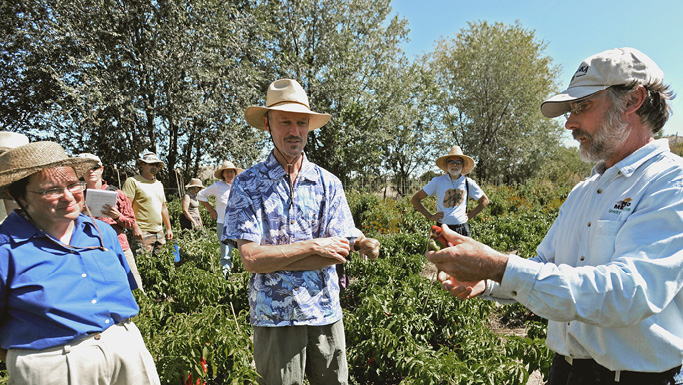
Photo by Robert Yee. NMSU, 2021.
Introduction
Effective Extension programming begins with understanding the needs, concerns, and opportunities within a community. New Mexico’s communities are diverse and include Hispanic, Indigenous, agricultural, rural, and urban populations with unique strengths, cultures, languages, and challenges.1 Because community needs vary across counties, a one-size-fits-all approach to Extension programming is often ineffective.
A needs assessment is a systematic process used to identify gaps between current and desired conditions to guide planning and decision-making.2 Respondents emphasized community assessments, county Strengths, Weaknesses, Opportunities, and Threats (SWOT) analyses, and data-driven program planning as essential components of effective Extension programming.3 Survey results also indicated that approximately half of responding county agents and county directors had five years or less of Extension experience, highlighting the importance of practical resources to support stakeholder engagement, needs assessment, and county plan-of-work development. New county agents are provided orientation and training resources through the NMSU Self-Study Guide for the New Extension Agent; however, practical tools focused specifically on community needs assessment and county program planning remain important for successful Extension programming.4
This publication is the first in a three-part series on Extension program development. Series 1 focuses on community needs assessment, Series 2 on program planning, and Series 3 on program implementation, evaluation, and impact reporting. Together, the series provides practical guidance for New Mexico Extension agents.
The purpose of this workbook is designed to provide New Mexico Extension agents with practical guidance and tools for conducting county-level needs assessments. The workbook includes practical assessment and planning tools for Extension agents.5
County Community Profile
Why Develop a County Community Profile?
A community profile provides a foundation for conducting a needs assessment. Before identifying community needs, Extension agents should understand the county’s population, economy, agricultural industries, community resources, and demographic characteristics. A community profile helps agents recognize local strengths and challenges, identify underserved audiences, and interpret needs assessment results within the county’s unique context. The county community profile should include a county snapshot, community assets, and a review of existing data sources. Developing a community profile helps Extension agents understand local conditions before conducting a needs assessment. Additional guidance is available in the Self-Study Guide for the New Extension Agent.4
County Snapshot: summarizes key demographic, economic, agricultural, and community characteristics. Understanding these characteristics helps agents identify trends, opportunities, and potential challenges that may influence Extension programming.
Community Assets: the people, organizations, institutions, facilities, and resources that contribute to a community’s well-being. Identifying community assets helps agents recognize existing strengths, build partnerships, and leverage local resources to address community needs.
Existing Data Sources: provide valuable information about community conditions and trends before additional information is collected. Community profiles and secondary data sources are commonly recommended as the foundation for community needs assessments.5
Stakeholder Identification
Identifying stakeholders is an important step in the needs assessment process. Stakeholders are individuals, groups, or organizations that are affected by community issues or have an interest in Extension programs.
Underserved audiences are individuals or groups who may have limited access to Extension programs or whose needs are not adequately represented in community decision-making processes. Identifying underserved audiences helps ensure that Extension programs are inclusive and responsive to the needs of all community members. Examples may include populations facing language, cultural, geographic, economic, educational, technological, or transportation barriers. Underserved audiences vary across counties and should be identified through local data collection and stakeholder engagement.
Community partners are organizations that can assist with identifying needs, delivering programs, and reaching target audiences. Potential partners may include school districts, New Mexico Department of Agriculture, Soil and Water Conservation Districts, acequia associations, tribal governments, county governments, producer organizations, 4-H leaders, and Future Farmers of America (FFA) advisors. Additional partners may include irrigation districts (e.g., Elephant Butte Irrigation District), county health councils, community colleges, pueblo and tribal Extension programs, local economic development organizations, and farmers market associations.
Stakeholder Engagement
Stakeholder engagement is one of the most important components of a community needs assessment. New Mexico communities are diverse and often differ significantly in culture, language, geography, economic conditions, and access to resources.
Key stakeholder interviews are one-on-one conversations with individuals who possess knowledge of community issues and opportunities. Sample interview questions are provided in Appendix 2. In some cases or counties, being bilingual is important.
Community Meetings provide residents with opportunities to discuss local issues and identify priorities. Advisory Committees provide ongoing guidance throughout the needs assessment and program planning process.
Community Needs Assessment
Community needs assessments involve collecting information from stakeholders to identify community priorities, concerns, and opportunities.
Surveys can be used to collect information from a broad range of stakeholders and identify community priorities, program needs, and emerging issues. A sample survey is provided in Appendix 1.
Focus Groups allow agents to gather detailed feedback from small groups of participants and gain a deeper understanding of community concerns and perspectives. Sample focus group questions are provided in Appendix 3.
Listening Sessions provide community members with an opportunity to discuss local issues, concerns, and opportunities in an open setting.
Community Needs Inventory
After collecting information from surveys, interviews, community meetings, advisory committees, and existing county data, Extension agents should summarize the findings in a community needs inventory. The inventory helps organize assessment findings.
Identified Needs are issues that community members consistently recognize as important. These may include concerns related to drought preparedness, water management, acequia management, beginning farmer and rancher education, agricultural profitability, youth workforce development, housing affordability, and community health. Needs identified by multiple stakeholder groups often represent the highest priorities for Extension programming.
Emerging Issues are new concerns or opportunities that may affect the community in the future. Examples may include changing environmental conditions, workforce challenges, demographic shifts, the use of artificial intelligence and digital technologies, or alternative agricultural enterprises. Recognizing emerging issues helps agents prepare programs that address future needs and opportunities.
Unmet needs are issues for which there are currently limited educational programs, services, or resources. These needs may involve underserved audiences, participation barriers, or gaps in existing programs. Addressing unmet needs can help Extension expand its reach and increase program impact within the county. A sample community needs inventory worksheet is provided in Appendix 4.
County SWOT Analysis
A Strengths, Weaknesses, Opportunities, and Threats (SWOT) analysis is a planning tool used to evaluate a county’s internal strengths and weaknesses and external opportunities and threats. Conducting a SWOT analysis helps Extension agents better understand local conditions, identify factors that may influence program success, and develop strategies that address community priorities.
Strengths are internal assets and advantages that support Extension programming and community development. Examples may include strong community partnerships, active advisory committees, agricultural resources, local leadership, volunteer support, and existing Extension programs.
Weaknesses are internal limitations that may affect program delivery or community development efforts. Examples may include limited staffing, budget constraints, low program participation, language barriers, or lack of volunteers.
Opportunities are external conditions that may create favorable circumstances for future programming and community growth. Examples may include value-added agriculture, local food systems, outdoor recreation, renewable energy development, and tribal economic development.
Threats are external factors that may negatively affect communities or Extension programs. Examples may include prolonged drought, declining rural populations, water shortages, workforce shortages, changing regulations, or reductions in public funding.
The SWOT analysis should be completed using information collected during the needs assessment process and used to support priority setting and program planning. A sample county SWOT analysis worksheet is provided in Appendix 5.
Prioritizing Community Needs
Following the community needs inventory and SWOT analysis, Extension agents should prioritize identified needs to determine where limited time, funding, and resources can have the greatest impact. A prioritization process helps agents focus on the most important and feasible needs.
Importance Ranking evaluates the significance of each identified need based on information collected during surveys, interviews, focus groups, community meetings, advisory committees, and existing county data. Factors to consider may include the number of people affected, stakeholder interests, urgency of the issue, and potential benefits of addressing the need.
Feasibility Ranking evaluates the practicality of addressing a need based on information identified through the SWOT analysis. Factors may include available resources, staff expertise, community partnerships, funding opportunities, organizational capacity, and potential barriers to program implementation.
Priority Selection combines information from the community needs inventory, importance ranking, and feasibility ranking to identify the highest-priority needs for Extension programming. Selected priorities should reflect stakeholder input, local conditions, available resources, and the mission of Cooperative Extension.
The prioritization process provides a foundation for developing county plans of work and allocating resources to programs with the greatest potential impact. A sample community Needs Prioritization Worksheet is provided in Appendix 6.
Program Planning
The prioritized community needs identified through the assessment should guide county program planning. Agents should develop programs that address high-priority needs, target appropriate audiences, and support desired outcomes.
Annual County Needs Assessment Summary
The Annual County Needs Assessment Summary provides a concise overview of the assessment findings and serves as a reference for county program planning. The summary should be completed after the community needs inventory, SWOT analysis, and prioritization process have been finalized.
Top Community Needs are the highest priority issues identified through stakeholder input, data collection, and the prioritization process. These needs represent the most important concerns and opportunities within the county.
Priority Programs are the Extension programs and activities developed to address identified community needs. Programs should align with county priorities, available resources, and stakeholder interests.
Future Opportunities are emerging issues, partnerships, funding opportunities, or program areas that may warrant additional attention in future years. Identifying future opportunities helps agents remain responsive to changing community conditions and needs.
The Annual County Needs Assessment Summary can support county plans of work, advisory committee discussions, program reporting, and future planning efforts. There are several ways to conduct the annual County Needs Assessment including online survey tools and group facilitation meetings.
References
- Abdul-Rahman, F. (2012). Family resource management needs assessment in New Mexico. Journal of Extension, 50(5), Article 18. https://doi.org/10.34068/joe.50.05.18
- Witkin, B. R., & Altschuld, J. W. (1995). Planning and conducting needs assessments: A practical guide. SAGE Publications.
- Malone, A., Vitale, P., Herrera, C., Boren, J., Carpio, C., & Rashin, K. R. L. (2025). Needs and program effectiveness of the Cooperative Extension Service in New Mexico. Journal of NACAA, 18(2). https://www.nacaa.com/journal/f95c9db3-dbfa-43d8-bc47-d5567559085a
- New Mexico State University Cooperative Extension Service. (2018). Self-study guide for the new Extension agent (Rev. ed.). New Mexico State University. https://aces-employee.nmsu.edu/documents/2018-self-study-guide.pdf
- Garst, B. A., & McCawley, P. F. (2015). Solving problems, ensuring relevance, and facilitating change: The evolution of needs assessment within Cooperative Extension. Journal of Human Sciences and Extension, 3(2), 26–47. https://scholarsjunction.msstate.edu/jhse/vol3/iss2/4/
Appendix
Appendix 1 – Sample Survey
1. What are the top three agriculture, family, youth, or community issues in your county?
2. Which topic would you most like Extension to provide education or training on?
If applicable, please describe the specific topic or issue you would like addressed:
3. Which population groups are underserved in your county?
▢ Youth
▢ Older adults
▢ Tribal communities
▢ Spanish-speaking residents
▢ Beginning farmers and ranchers
▢ Low-income households
▢ Other __________
4. Have you attended an Extension program before?
5. What is the best way for Extension to reach you?
Appendix 2 – Sample Interview Questions
- What are the biggest needs in your community?
- What agriculture, family, youth, or community issues concern you most?
- What should Extension do more of in this county?
- Are there groups or communities that Extension is not currently reaching?
- What educational programs would be most helpful in this county?
- What is working well in your community?
- What new issues or challenges are emerging?
- What prevents people from attending Extension programs?
- What organizations, agencies, or community leaders should Extension work with?
- What advice do you have for improving Extension programs?
Appendix 3 – Sample Focus Group Guide
Introduction
Thank you for participating today. We would like to learn about the needs, concerns, and opportunities in our community. Your feedback will help guide future Extension programs.
Facilitator Note (Optional)
The facilitator may use a Nominal Group Technique (NGT) to help participants identify, discuss, and prioritize community needs. This process allows all participants to contribute ideas and helps the group reach consensus on the most important issues.
Discussion Questions
7. Is there anything else you would like Extension to know?
Suggested Group Size: 6–10 participants
Suggested Length: 30–60 minutes
Appendix 4 – Community Needs Inventory Worksheet
|
Identified Need |
Source of Information |
Priority |
Notes |
|
Rising fertilizer and fuel costs |
Producer survey, advisory committee |
High |
Increasing production costs for farmers and ranchers |
|
Water shortages and drought conditions |
Community meeting, producer interviews |
High |
Concerns about irrigation water and forage availability |
|
Limited agricultural labor availability |
Producer interviews, advisory committee |
Medium |
Difficulty hiring and retaining seasonal workers |
Reflection Questions:
- Which needs were identified most often?
- Which needs affect the largest number of people?
- Which needs are not being addressed by current programs?
Top Three County Priorities
Appendix 5 – County SWOT Analysis Worksheet
|
Strengths Strong community partnership |
Weaknesses Limited staffing |
|
Opportunities Value-added agriculture |
Threats Drought and water shortages |
Reflection Questions
- Which strengths can help address community needs in Appendix 4?
- Which weaknesses limit Extension programs?
- Which opportunities should be pursued?
- Which threats may affect the community?
- What are the county’s top priorities?
Appendix 6- Community Needs Prioritization Worksheet
|
Step 1. Review of the Scoring Guide |
||
|
Score |
Importance |
Extension Capacity |
|
1 |
Low |
Very Limited |
|
2 |
Below Average |
Limited |
|
3 |
Moderate |
Moderate |
|
4 |
High |
Strong |
|
5 |
Very High |
Very Strong |
|
Step 2. Complete the Prioritization Worksheet |
||||
|
Community Need |
Importance |
Extension Capacity (1–5) |
Total Score |
Priority Rank |
|
Water conservation education |
5 |
4 |
9 |
1 |
|
Rising fertilizer and fuel costs |
4 |
3 |
7 |
2 |
|
Total Score = Importance + Extension Capacity, Priority Rank should be assigned based on total score, with the highest score receiving Rank 1. |
||||
|
Step 3. Identify Priority Needs for Program Planning |
|
|
Rank |
Priority Need |
|
1 |
|
|
2 |
|
|
3 |
|

Dr. Allen A. Malone is the Associate Director for the Cooperative Extension Service at New Mexico State University. He is an Agricultural Economics graduate of Prairie View A&M University and holds a dual doctorate degree in Agricultural Education & Leadership from Texas A&M and Texas Tech University. His extension career expands over 30 years in which he has served in several capacities, working with youth and advocating and supporting their education.
To find more resources for your business, home, or family, visit the College of Agricultural, Consumer and Environmental Sciences on the World Wide Web at pubs.nmsu.edu.
Contents of publications may be freely reproduced, with an appropriate citation, for educational purposes. All other rights reserved. For permission to use publications for other purposes, contact pubs@nmsu.edu or the authors listed on the publication.
New Mexico State University is an equal opportunity employer and educator. NMSU and the U.S. Department of Agriculture cooperating.
July 2026 Las Cruces, NM