Guide H-512
Bernhard Leinauer and Leslie Beck
College of Agricultural, Consumer and Environmental Sciences, New Mexico State University
Authors: Respectively, Extension Forest and Fire Specialist; Extension Pecan Specialist; and Luna County Extension Director and Agent. All from New Mexico State University. (Print-Friendly PDF)
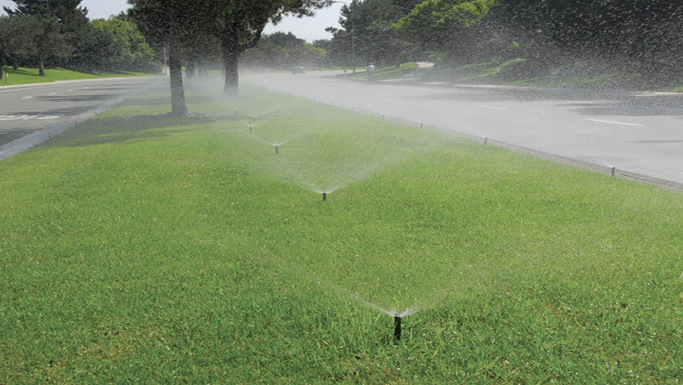
Photo by Mike Baron. The Toro, Co., 2026. Used with permission.
Key Message
Water conservation in turfgrass is achieved not only through species or variety selection, but also through efficient irrigation management and matching the turfgrass to its intended function.
What Homeowners and Turf Managers Should Know
Turfgrass areas are an integral part of many urban and peri-urban landscapes, providing more than just visual appeal. Well-managed turf helps reduce surface temperatures and mitigate urban heat, creating cooler and more comfortable outdoor environments. Turfgrass also stabilizes soil, reduces erosion, suppresses dust, and improves infiltration of rainfall and irrigation water. In addition, turfgrass provides safe, resilient surfaces for recreation and contributes to the overall livability of communities.
Because of these benefits, turfgrass is often a necessary and functional component of the landscape. At the same time, its water requirements have come under increasing scrutiny, leading many to search for ways to reduce irrigation demand. However, water conservation efforts must be balanced with the need for turf areas to remain functional, durable, and safe.
Selecting an appropriate turfgrass therefore involves more than simply choosing a species or variety labeled as “low water use.” Although turfgrass species differ in their potential water requirements, actual water use is also strongly influenced by climate, irrigation management, and the intended use of the site. Sustainable turf management requires balancing water conservation goals with desired aesthetic appeal and functional requirements such as traffic tolerance, seasonal performance, and durability.
Rethinking the Idea of “Low-Water Use” grasses
Turfgrasses are often described as either “high-water use” or “low-water use.” Although convenient, this classification can be misleading. Unlike household appliances, turfgrasses do not have a fixed water requirement tied strictly to their species or variety.
Water loss from turfgrass occurs through evapotranspiration (ET), a process driven largely by climate conditions such as temperature, sunlight, wind, and humidity. These factors change daily and seasonally, meaning that water needs are constantly shifting. As a result, no grass consistently uses a set amount of water across all conditions. Labeling a species as inherently “low water use” oversimplifies a system that is strongly influenced by climate and management. Research suggests that most of the variation in ET is driven by environmental factors such as temperature, solar radiation, humidity, and wind; whereas plant characteristics account for a much smaller portion of the variation. For example, studies have estimated that climatic factors explain approximately 60–70% of the variation in evapotranspiration, while plant-related factors account for only 10–20%.1 Similarly, Ebdon et al. (1998) reported that approximately 87% of the variation in water use among Kentucky bluegrass cultivars was attributable to environmental conditions rather than genetic differences among cultivars.2
Species Selection Matters—But So Does Function
Nonetheless, turfgrass species differ in their annual irrigation requirements. In general, warm-season grasses such as bermudagrass require less irrigation over a growing season than cool-season grasses such as Kentucky bluegrass or tall fescue. This difference is important and can provide substantial water savings in regions where warm-season grasses are adapted.
However, these lower annual water requirements are due in a greater part to the growing season of warm-season grasses. In our climate, warm-season grasses enter dormancy during cooler months, often for five to six months each year. During this period, the turf turns brown, growth slows or stops, and little to no irrigation is required; as a result, lower annual water use may come with tradeoffs. Turf areas may not provide the same year-round green cover or functionality expected for residential landscapes, parks, or sports fields. Cool-season grasses, while requiring more irrigation during summer months, provide longer periods of green cover and usability. In this context it is interesting to note that in a large meta-analysis of published evapotranspiration studies of cool-season turfgrasses, Braun et al. (2022) reported that Kentucky bluegrass exhibited an average evapotranspiration rate of 5.35 mm d—¹, which was 31% lower than that of tall fescue.3 Such findings demonstrate that differences among species and varieties can exist and should not be ignored, but environmental conditions remain the primary driver of water use. Therefore, selecting a turfgrass species involves balancing water conservation with desired appearance, traffic tolerance, and seasonal performance.
Moreover, differences in irrigation requirements can be relatively small under typical field conditions. For example, even if two varieties differed in water use by as much as 3 mm per day—a range commonly reported in the literature—the difference in irrigation run time for a sprinkler applying 0.65 inches of water per hour would amount to only about 10 to 12 minutes per day. In practice, most homeowners don’t know the evapotranspiration at their location and cannot adjust irrigation run times based on species or variety used in their landscape.
Irrigation Practices Drive Water Use
Perhaps the most important factor affecting water use is not the grass itself, but how much water is applied. In most cases, irrigation practices determine total water consumption. The amount of irrigation water needed for a turf area can be understood as the result of three main factors. First, climate determines how much water is lost through evapotranspiration; hot, dry, and windy conditions increase water loss, while cooler or more humid conditions reduce it.
Second, this atmospheric demand is adjusted by a turfgrass factor, commonly called a crop coefficient, which reflects species, management intensity, and expectations for visual quality. Turfgrass maintained for a lush, green appearance will require longer run times than turf managed at lower input levels.
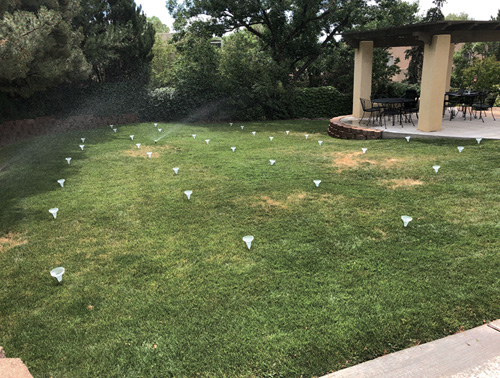
Third, and often underestimated, is the uniformity of the irrigation system. No system applies water perfectly evenly. To prevent dry spots, extra water is typically applied, which leads to overwatering in other areas. The more uniform the system, the closer water application can match actual needs.
In many situations, improving irrigation system performance—such as fixing leaks, adjusting sprinklers, or correcting pressure issues—results in greater water savings than switching to a different turfgrass species. For existing turf areas, evaluating and improving the irrigation system is often the most effective first step toward conserving water.
Matching Turfgrass to its Function
While water use is an important consideration, turfgrass areas are rarely installed for appearance alone. Many are expected to withstand regular use by children, pets, and recreational activities. Athletic fields and public spaces require surfaces that remain safe and functional under repeated wear. For these uses, traffic tolerance is often a critical characteristic. In our region, Kentucky bluegrass, perennial ryegrass, and bermudagrass perform well because they tolerate and recover from heavy use.
By contrast, some grasses promoted as “low water use,” such as buffalograss and other native grass alternatives, generally have limited tolerance to traffic and may not provide the uniform playing surfaces required for recreational use. Under heavy use, these grasses may thin out, resulting in bare soil, dust, weed invasion, and greater maintenance challenges.
A common misconception also involves Kentucky bluegrass and tall fescue. Kentucky bluegrass is often labeled as a “high water-use” grass, while tall fescue is promoted as drought resistant. However, research has shown that the irrigation required to maintain acceptable visual quality is either similar for both species and even lower for Kentucky bluegrass. Differences become more apparent during prolonged dry periods or irrigation restrictions. Tall fescue may survive because of its deep root system, but recovery following drought stress can be limited. Kentucky bluegrass, in contrast, possesses rhizomes that allow it to recover more effectively once irrigation resumes. When both maintenance requirements and recovery potential are considered, Kentucky bluegrass is often the more reliable choice for many managed turf areas.
A Practical Perspective on Water Conservation
Selecting a turfgrass based solely on perceived water use can lead to unrealistic expectations. Water consumption is shaped by climate, irrigation practices, system performance, and the intended use of the turf area. In many cases, the greatest opportunities for water savings come from improving irrigation efficiency rather than changing grass species. At the same time, the selected turf must meet functional requirements such as traffic tolerance, durability, and seasonal performance. Taking these factors into account leads to more practical, effective, and sustainable decisions.
References
- Katerji, N., & Rana, G. (2011). Crop reference evapotranspiration: A discussion of the concept, analysis of the process and validation. Water Resource Management, 25, 1581–1600. https://doi.org/10.1007/s11269-010-9762-1
- Ebdon, J.S., Petrovic, A.M., & Zobel, R.W. (1998). Stability of Evapotranspiration Rates in Kentucky Bluegrass Cultivars across Low and High Evaporative Environments. Crop Science, 38, 135-142. https://doi.org/10.2135/cropsci1998.0011183X003800010023x
- Braun, R. C., Bremer, D. J., Ebdon, J. S., Fry, J. D., & Patton, A. J. (2022). Review of cool-season turfgrass water use and requirements: I. Evapotranspiration and responses to deficit irrigation. Crop Science, 62, 1661–1684. https://doi.org/10.1002/csc2.20791

Bernd Leinauer is a professor and Extension Turfgrass Specialist in the Department of Extension Plant Sciences. He received his M.S. and Ph.D. degrees in crop and soil science from Hohenheim University in Stuttgart, Germany. His Extension and research program focuses on developing water management strategies for turf areas to reduce the amount of water used for irrigation.
To find more resources for your business, home, or family, visit the College of Agricultural, Consumer and Environmental Sciences on the World Wide Web at pubs.nmsu.edu/
Contents of publications may be freely reproduced for educational purposes. All other rights reserved. For permission to use publications for other purposes, contact pubs@nmsu.edu or the authors listed on the publication.
New Mexico State University is an equal opportunity employer and educator. NMSU and the U.S. Department of Agriculture cooperating.
July 2026, Las Cruces, NM