Circular 713
Christopher D. Allison and Jason L. Turner
College of Agricultural, Consumer and Environmental Sciences, New Mexico State University
Authors: Respectively, Rangeland Scientist and Endowed Chair, Linebery Policy Center for Natural Resource Management; and Professor/Extension Horse Specialist, Department of Extension Animal Sciences and Natural Resources (ASNR). All from New Mexico State University. (Print Friendly PDF).
Introduction
Few issues, if any, evoke as wide an array of opinions and feelings among the public as wild and free roaming horses do. Overpopulation of horses on rangelands causes degradation of native rangeland with adverse consequences for the native and domestic mammals sharing the same ecosystem. Management of wild/feral/free roaming equids on western rangelands is one of the most challenging issues facing federal, state, private, municipal, and tribal lands management. Balancing the welfare of these equines, livestock, wildlife, and rangeland health is one of the more important tasks we face in western range management.
Origins
Horses were present in the Americas up to 4 million years ago, but according to fossil records, they were not here 10,000 years ago. Horses on western rangelands were re-introduced by Spanish explorer Hernan Cortes in 1519 and spread from Spanish settlements in the Southwest to the northern Rockies and Great Plains by the early 17th century. New Mexico Statutes1 states that a “wild horse” is an unclaimed horse on public land that is not an estray. A feral horse is a free roaming horse of domesticated stock. Feral horses are descended from domesticated stock that have strayed into the wild and remain there and survive and reproduce there. Most, if not all, free roaming horses on New Mexico rangelands are feral horses. Mustangs of the American West are the most common feral horse. If you were to release individuals from different horse breeds onto the western rangeland, after a few generations you would have the Mustangs we have today.
1971 Wild-Free Roaming Horses and Burros Act
The Wild-Free Roaming Horses and Burros Act (WFRHBA) was passed by the U.S. Congress in 1971. This law states that wild horses and burros are “living symbols of the historic and pioneer spirit of the West” and that the Bureau of Land Management (BLM) and the U.S. Forest Service (USFS) have the responsibility to manage and protect these animals within areas where wild horses and burros were found roaming in 1971.2 The WFRHBA has created much controversy since its implementation, perhaps due to the conflicting goals of protecting and managing wild horses and burros while maintaining “a thriving natural ecological balance on the public lands.” Over the years, the approach to management and protection has led to a significant increase in the number of wild horses and burros on the land, which is unsustainable both financially and ecologically.
Responsible Entities for Categories of Wild and Free Roaming Horses in New Mexico
Horses Protected under the WFRHBA
The BLM identifies two Herd Management Areas (HMA) in New Mexico. The Bordo Atravesado HMA (Figure 1) is approximately 15 miles northeast of Socorro and consists of 19,605 acres. The Carracas Mesa HMA is 35 miles northeast of Bloomfield and consists of 32,086 acres. The adjacent USFS Jicarilla Wild Horse Territory (WHT) is approximately 76,000 acres; the BLM and USFS jointly manage the Jicarilla wild horse herd. The Jarita Mesa WHT is located approximately 20 miles northeast of El Rito and consists of 55,000 acres of National Forest land. The Caja del Rio WHT is approximately 8 miles west of Santa Fe and consists of 8,728 acres of National Forest land in the Caja Plateau. For 2025,3 the BLM reported a total of 85 horses in the two New Mexico HMA’s. The most recently published data for the USFS WHT is from 2014, and it reports 400 horses on the Jicarilla, 170 horses on the Jarita Mesa, and 72 horses on the Caja del Rio.4 Clearly, horses protected under the WFRHBA in New Mexico (Figure 2) represent a very small part of the more than 73,130 horses and burros managed by the federal government in the West.3
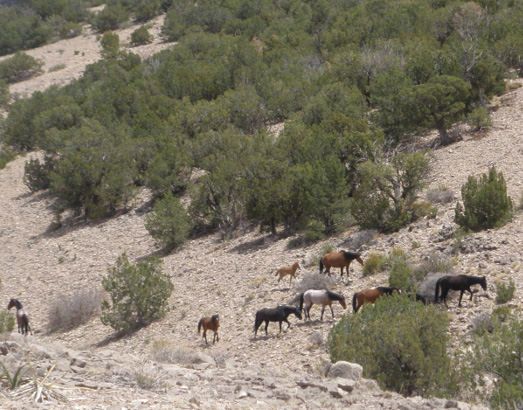
Figure 1. Wild horses on the Bordo Atravesado Herd Management Area. Source: Bureau of Land Management (BLM), 2023. Source: https://www.blm.gov/press-release/bureau-land-management-plans-wild-horse-gather-socorro
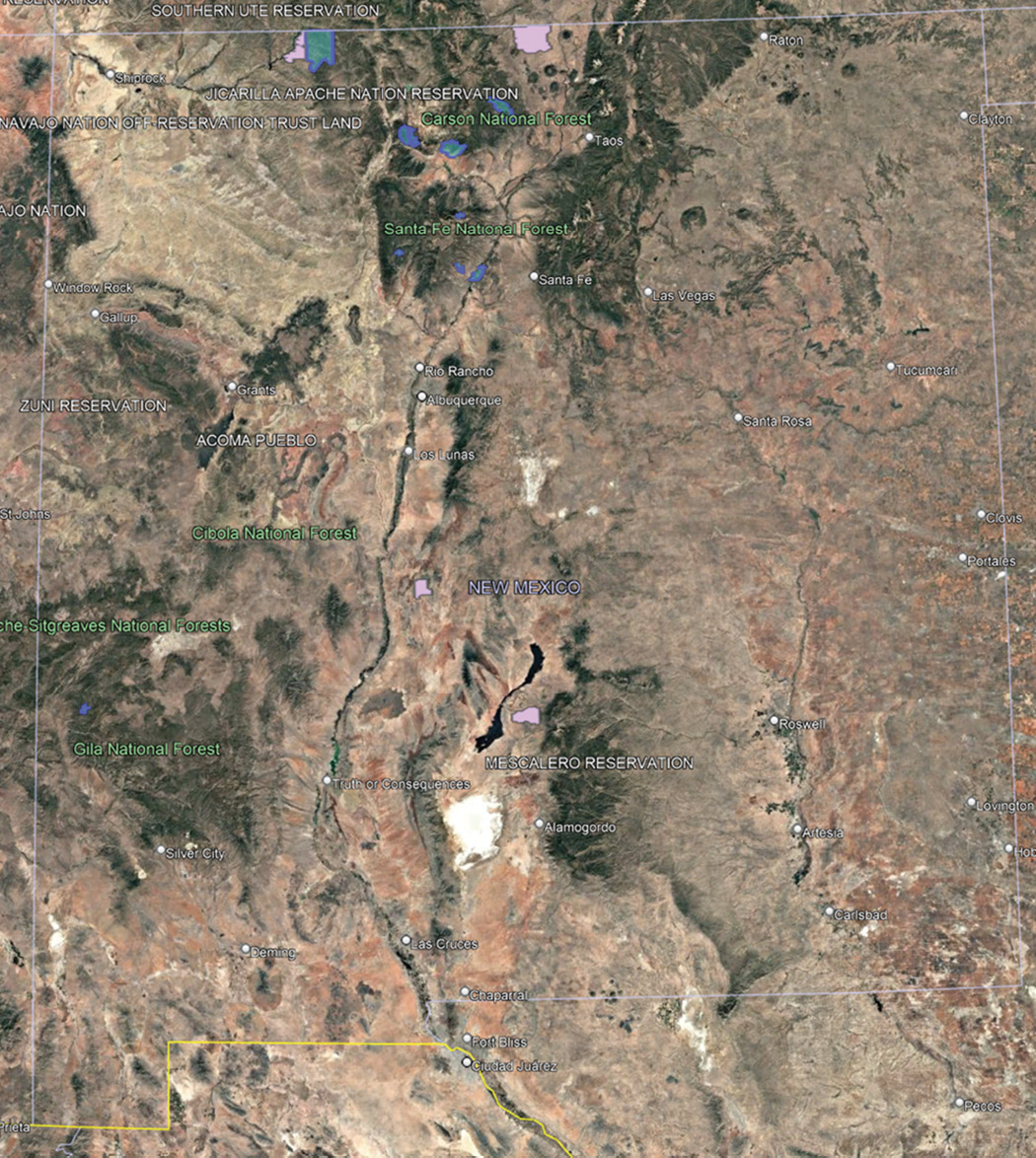
Figure 2. Map of Herd Management Areas (pink shading) and Wild Horse Territories (blue shading) in New Mexico designated by the U.S. Bureau of Land Management and U.S. Forest Service, respectively. Map courtesy of Dr. Nick Ashcroft, Senior Natural Resource Policy Analyst, Linebery Policy Center for Natural Resource Management.
Horses on Tribal Lands
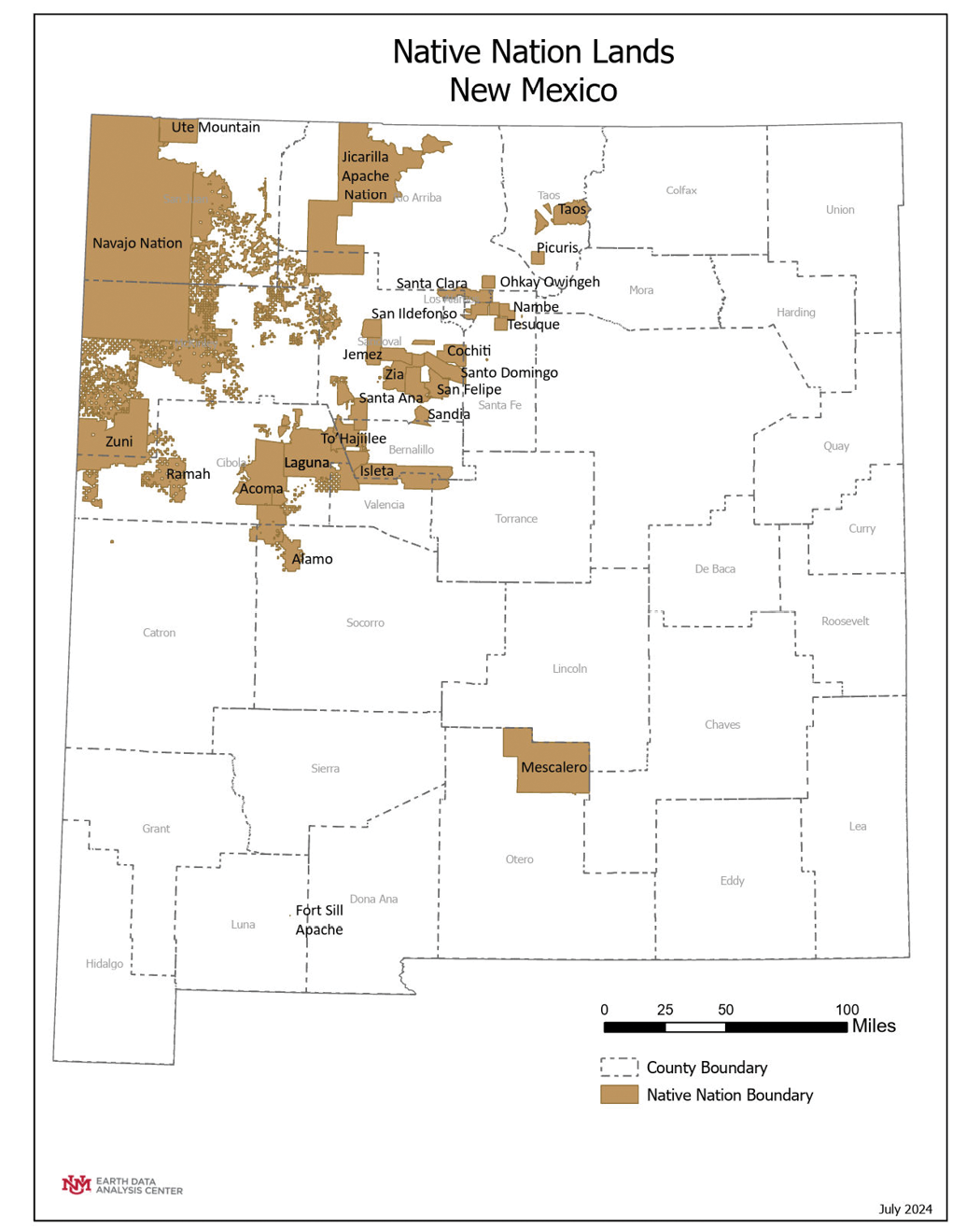
New Mexico is home to over 20 sovereign tribal nations (Figure 3). Tribes have jurisdiction and manage their own natural resources including wild horses. Policies for managing free-roaming horses are determined by each individual tribe.
Horses on New Mexico Public Lands
Public lands are perceived by most as lands administered by the Bureau of Land Management and the USDA Forest Service. However, New Mexico’s state wild horse law does not apply to these federal lands. In New Mexico, lands owned by cities and municipalities are generally classified as “public land”. County and municipal properties such as parks and golf courses are affected by this legislation and free-roaming wild horses in New Mexico are protected under this statute.1 In recent years, legislation put forth in the New Mexico legislature has sought to amend the Livestock Code by defining “free-roaming horse” and how they are managed; however, this legislation has not yet been incorporated into state law.
Free Roaming Horses on Private Land
New Mexico Statutes5 state “It is unlawful for a person or his agents or employees having charge of livestock to permit or allow the livestock to go upon the lands of others in this state for the purpose of grazing or watering upon any waters upon the lands without the permission of the owner or legal claimant or his agent. Any livestock found to be in trespass upon the lands of another or running at large upon any public highway that is fenced on both sides or running at large within the limits of any municipality, town or village, whether incorporated or not, or within a military reservation or enclave is subject to impoundment by an agent of the [New Mexico Livestock] Board.”6
Population Control for Wild and Free Roaming Horses in New Mexico
Natural Means of Population Control
Wild horse populations will naturally increase, if left unchecked, to a level that outstrips the rangeland ability to produce adequate vegetation for survival of range livestock and wildlife.
Predators, such as cougar, wolves, coyotes and bears cannot effectively control wild and free roaming horse populations. Coyotes are primarily scavengers and predators of small mammals and birds. Large predators, when abundant, can influence the dynamics of free-ranging ungulates. Cougars are ambush predators and require habitats that have broken topography and tree cover, whereas equids favor habitats having more extensive viewsheds. Cougar and bear populations are small and do not occupy significantly large enough areas to affect horse populations. The Mexican Grey Wolf population is aggressively expanding and will, undoubtedly, increasingly use wild horses as a food source. The extent that wolves will impact wild horse herds is not known but is speculated to be a significant variable in horse population dynamics. Currently, the most prominent factor influencing wild horse population dynamics is habitat productivity. Unfortunately, wild horse populations will overwhelm rangeland productivity and result in habitat degradation and starvation of resident herds of wild equids which is the main natural cause of population decline.
Human Intervention for Population Control
The BLM has removed wild horses and burros from Herd Management Areas (HMA) to control population size and to keep numbers below the appropriate management level (AML) on specific HMA. The animals removed have either been placed for adoption or held in off-range corral and pasture facilities for the long term. As removal rates typically exceed the number of annual adoptions, the population size in off-range holding facilities has grown significantly over the years as has the expense to provide routine care for these animals.7 For non-ambulatory animals, humane euthanasia is often used to minimize suffering. In the search for sustainable means of population control on the range, most efforts have focused on birth control practices. With nearly 50 years of research to draw upon, readers are directed to the following two references that provide greater detail in summarizing the many studies in this area.7,8
Overview. Female horses are seasonally polyestrous which means that they have regular 21-day cycles when the season permits. Horses are long day (photoperiod) breeders, and domesticated mares typically show routine estrous periods from March to October in the Northern Hemisphere, although this is affected by latitude, when body fat reserves and nutrient content of the diet are adequate to support reproduction. Although stallions produce sperm year-round, peak sperm production occurs during the long days when mares show normal cyclicity. Both males and females reach sexual maturity between 1 and 2 years of age with 18 months considered the average. This range is for both domesticated and free-roaming horses. Pregnant mares have a gestation length of approximately 340 days, and the first postpartum estrus (foal heat) can occur approximately 5 to 12 days following birth. Furthermore, when nutrition is adequate, fertile mares can foal on an annual interval.8
Review of Birth Control Methods and Limitations
The search for contraceptive agents or methods effective in controlling reproduction began not long after wild horses became protected by the 1971 Act. Since then, several approaches have been tried. Some of those approaches have been abandoned for a variety of reasons, while others showing positive preliminary outcomes have been further investigated. The Committee to Review the Bureau of Land Management Wild Horse and Burro Management Program, hereafter referred to as the Committee, identified the following criteria as the most important when selecting fertility-control methods for free-ranging horses and burros.8
- Delivery method. An ideal method would allow for convenient administration of the agent to large number of horses without the need to gather and individually handle and treat each horse. Currently, no such ideal exists and the spectrum ranges from darting horses from hundreds of yards away to more invasive procedures such as surgical sterilization of males and females.
- Availability. The product needs to be readily available, in terms of licensing and approved uses, in quantities that would achieve population-level effects when used. This also refers to the availability of the skilled personnel (e.g., helicopter pilot, dart gunner, veterinarian, etc.) needed to carry out the administration of the product to the horses.
- Efficacy. The agent must not only be effective at controlling reproduction at the individual animal level, but it must also demonstrate the desired impact (fewer births) at the population level.
- Duration of effect. A product with a multi-year duration of effect would be more efficient in terms of financial and personnel resources required to administer the treatment while also minimizing the need for frequent handling of the horses during treatment.
- Potential physiological and behavioral side effects. The ideal treatment would not harm the welfare of the horses, and it would not eliminate sexual behavior or change social structure of the horses substantially.
Early efforts for birth control in wild horses investigated the use of steroid hormones to manipulate reproductive function in both sexes. While there were some positive impacts observed, this approach has largely been abandoned due to challenges with criteria 1, 4, and 5 identified by the Committee.8,9 Similarly, the use of castration or vasectomy in stallions as well as ovariectomy in mares prevents reproduction at the individual level. However, these surgical interventions are expensive in terms of resources required, pose great risk to animal welfare, the duration of effect is permanent, and they do not always reduce birth rates at the population level.8.9 The use of Intrauterine Devices (IUD) to inhibit reproduction in mares has shown mixed results in terms of reduced fertility and animal safety, and IUDs require more resources for the individual handling of the mares during treatment.8,9
Immunocontraception Methods and Effectiveness
Contraceptive vaccines stimulate the animal’s own immune system to produce antibodies that will have a negative impact on fertility.7 The search for an effective immunocontraceptive in wild horses began in the 1980s and over the years two key approaches have received the most investigation. First, is the use of porcine zona pellucida (PZP) in various final forms. The second approach is immunizing the horse against the hormone GnRH to impede fertility.8
The zona pellucida (ZP) is the protective glycoprotein coat that surrounds the oocyte (ovum or egg) within the ovary. ZP is where a sperm binds to the egg during the process of fertilization which triggers further maturation of the sperm to allow it to complete fertilization. Vaccinating mares with PZP causes them to make antibodies to the PZP, but these antibodies also bind to the mares’ ZP which blocks fertilization by sperm.8 There have been research trials using a variety of PZP formulations but the most promising results have been with a product called PZP-22 which demonstrates long-lasting, yet reversible effects on mare fertility. In a study conducted by Turner et al. (2007), for the three years following PZP-22 treatment, fertility was reduced by 89%, 74%, and 41% relative to untreated mares, returning to full fertility in the fourth year.10
Gonadotropin releasing hormone (GnRH) is a small neuropeptide produced in the hypothalamus that stimulates the release of follicle stimulating hormone (FSH) and luteinizing hormone (LH) from the anterior pituitary. Both FSH and LH are instrumental in guiding the ovary from follicular recruitment and development to ovulation and the development of luteal tissue that secretes progesterone for maintenance of pregnancy. Therefore, stimulating antibody production that binds GnRH and prevents its effect on FSH/LH is the basis for inhibiting reproduction through this method.8 The most widely used GnRH vaccine in the USA is a product called GonaCon, which has been shown to reduce fertility in a variety of wild ungulate species.7 However, the reduced fertility observed in wild mares treated with GonaCon is modest as it only reduced the foaling rate by 20-25% compared to controls.7 Further research is being conducted to determine treatment protocols that may improve the effectiveness of GonaCon for controlling reproduction in wild mares. In terms of reproductive function in the stallion, the USDA APHIS National Wildlife Research Center in Ft. Collins, Colorado, reported that GonaCon treatment decreases testosterone production and aggressive behaviors in stallions.11
For now, the use of PZP-22 appears to be the most effective method of immunocontraception in wild mares as it has the longest duration of reduced fertility while meeting most of the selection criteria put forth by the Committee.8 However, both GonaCon and PZP-products have limitations in terms of the delivery method and the financial resources required for gathering animals to be treated. The vaccine must be administered by hand via syringe, or it can be administered with a dart gun and dart syringe at distances around 30 to 40 yards. In either case, it is important to correctly identify and gather previously vaccinated individuals when administration of a vaccine booster is necessary.
Beyond the inherent need to gather animals for treatment, field personnel have reported it is quite difficult to repeatedly dart the same animal over time as would be needed for booster vaccinations.9 Recently, the USDA APHIS National Wildlife Research Center in Ft. Collins, Colorado, reported that immunization of mares against oocyte-specific growth factors, a different target than the ZP, is safe for use in pregnant mares and will suppress fertility in mares for at least one year with a single dose.12 This new approach that doesn’t require booster vaccination shows promise as a single-dose contraceptive solution.
Conclusion
After reviewing available data, challenges posed by wild and free-roaming horses in New Mexico stem from those horses on tribal and public lands and not horses protected by the WFRHBA, as the latter population in New Mexico is relatively small compared to other states in the West. If left unchecked, wild and free-roaming horses will continue to overgraze rangeland leading to rangeland degradation and watershed destruction. Rangeland ecosystems cannot withstand continued heavy use by wild equids and may never recover to their pre-wild horse diversity, and productivity.
Previous attempts to implement management practices to provide balance between wild and free-roaming equids and rangeland health have been hampered by lack of sufficient funding, and the legal intervention by public groups opposing traditional and historic management of rangelands.
Achieving successful outcomes in management of wild and free-roaming horses, stakeholders will require to collaborate and commit to unified management protecting all attributes of rangeland ecosystems. It is a formidable, but necessary, task. Rangeland health requires producers and consumers on rangeland to be in balance to secure long-term sustainability. Rangeland productivity and health is only achieved with continuous adjustments among consumer populations of livestock, wildlife and free-roaming horses.
References
- New Mexico Statutes. (2007). Wild horses; conformation, history and deoxyribonucleic acid testing; Spanish colonial horses; birth control. Public Law 77-18-5. https://nmonesource.com/nmos/nmsa/en/nav_date.do
- United States Congress. (1971) The Wild Free-Roaming Horses and Burros Act of 1971. Public Law 92-195. https://www.blm.gov/sites/default/files/programs_wildhorse_history_doc1.pdf
- US Bureau of Land Management. (2025, October 20). Program Data. https://www.blm.gov/programs/wild-horse-and-burro/about-the-program/program-data
- US Forest Service. (2025, October 20). Wild Horse and Burro Territories. https://www.fs.usda.gov/wild-horse-burro/territories/index.shtml
- New Mexico Statutes. (1999). Trespass and Running at Large. Public Law 77-14-3. https://nmonesource.com/nmos/nmsa/en/nav_date.do
- New Mexico Statutes. (2023). Impoundment of trespass livestock. Public Law 77-14-36. https://nmonesource.com/nmos/nmsa/en/nav_date.do
- Bechert, U.S., Turner Jr., J.W., Baker, D.L., Eckery, D.C., Bruemmer, J.E., Lyman, C.C., Prado, T.M., King, S.R.B., & Fraker, M.A. (2022). Fertility control options for management of free-roaming horse populations. Human–Wildlife Interactions, 16, 179-216.
- National Research Council. (2013). Using science to improve the BLM wild horse and burro program—A way forward. National Academies Press.
- Kane, A. (2018). A review of contemporary contraceptives and sterilization techniques for feral horses. Human–Wildlife Interactions, 12, 111–116.
- Turner Jr., J.W., Liu, I.K.M., Flanagan, D.R., Rutberg, A.T., & Kirkpatrick, J.F. (2007). Immunocontraception in wild horses: one inoculation provides two years of infertility. Journal of Wildlife Management, 71, 662–667.
- Levy, M., Johnston, C., Berta, M., Mundell, C., Hamby, H., Goldade, D., Cramer, C., & Bruemmer, J.E. (2025). GonaCon-Equine Vaccination Mimics Surgical Castration in Stallions [Abstract]. Proc. Symposium of the Equine Science Society.
- Mundell, C., Berta, M., Hamby, H., Goldade, D.A., Eckery, D.C., & Bruemmer, J.E. (2025). Development of a novel immunocontraceptive for use in feral mares [Abstract]. Proc. Symposium of the Equine Science Society.

Christopher D. Allison is a range scientist for the Linebery Policy Center for Natural Resource Management. He earned his Ph.D. in range science from Texas A&M University. His professional interests and expertise include range animal nutrition, grazing management, and range plant toxicology.
To find more resources for your business, home, or family, visit the College of Agricultural, Consumer and Environmental Sciences on the World Wide Web at pubs.nmsu.edu.
Contents of publications may be freely reproduced, with an appropriate citation, for educational purposes. All other rights reserved. For permission to use publications for other purposes, contact pubs@nmsu.edu or the authors listed on the publication.
New Mexico State University is an equal opportunity employer and educator. NMSU and the U.S. Department of Agriculture cooperating.
February 2026 Las Cruces, NM