Guide B-832
Casey Spackman, Dylan Burruss, Anthony Colin, and Varsha Singh
College of Agricultural, Consumer and Environmental Sciences, New Mexico State University
Authors: Respectively, Extension Rangeland Management Specialist, New Mexico State University (NMSU); State Noxious Weed Coordinator, New Mexico Department of Agriculture (NMDA); Program Manager, NMDA; and Extension Weed and Brush Specialist, NMSU. (Print Friendly PDF).
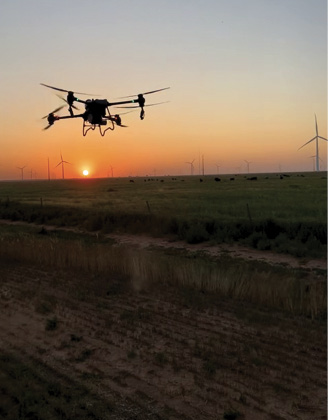
Figure 1. Chemical applicator drone over an agricultural field. Photo by Cory Allen of Range Solutions, LLC (used with permission).
Over the last two decades, the agricultural industry has seen rapid growth in the use of chemical applicator drones, also known as unmanned aerial application systems (UAAS). Since the early 1900s, people have been flying airplanes and helicopters to apply agricultural inputs, such as pesticides, fertilizers, and seeds, to crops and rangelands. Since then, manned flights have become an essential part of the U.S. agriculture industry, treating more than 145 million acres annually.1 Often, they are the most effective method for large, easily accessible areas.
As UAAS technologies continue to improve, they offer increasing benefits, such as rapid on-site deployment, precise spot or targeted treatments, operability over difficult terrain, and reduced pilot risk from low-altitude collisions. Despite these advantages, UAAS also have unique costs and legal requirements. Federal and state regulations are among the sources of these requirements. Before an entity can legally operate these systems, it must meet aviation, pesticide, and recordkeeping requirements. Many regulations apply differently based on your plans as an operator. Therefore, understanding these regulations and certifications is a critical first step in deciding whether UAAS are the right tool for the job.
Federal Requirements
Drones operate in national airspace and are therefore regulated by the Federal Aviation Administration (FAA). The rules for drone use are continually being updated and revised. Always check the FAA website at https://www.faa.gov/uas to stay current with these changes. Two federal certifications are required to operate a UAAS.
- Part 107 Remote Pilot Certificate: This is a commercial Small Unmanned Aircraft Systems (sUAS) operator license defined as flying for commercial, government, or any other non-recreational purpose. Operators must be at least 16 years old, pass the FAA Aeronautical Knowledge Test, and have a federal background check. Recertification is required every 24 months. The Aeronautical Knowledge Test covers rules such as maximum altitude, visual line of sight (VLOS), and airspace restrictions.
- Part 137 Agricultural Aircraft Operations Certificate: This license governs the dispensing or spraying of any substance by aircraft. This includes economic poisons (e.g., herbicides, pesticides, insecticides, disinfectants), fertilizers, soil treatments, and seeding that directly affect agriculture, horticulture, or forest preservation. There are several steps to obtain this certificate.
- An operator must first purchase and register their UAAS. The provided registration or identification number must be clearly displayed on the aircraft at all times, just like the tail number of a manned aircraft.
- Drones weighing between 0.55 and 55 pounds (including the weight of the substance being dispensed) fall under Part 107 and are required to be registered through FAADroneZone (https://faadronezone-access.faa.gov) to obtain a FA-number.
- Drones weighing 55 pounds or more (including the weight of the substance being dispensed) fall under the General Operating and Flight Rules (Part 91). This requires petitioning for an exemption and registering through the Civil Aviation Registry Electronic Services (CARES; https://cares.faa.gov/home) to obtain an N-number.
- Operators of UAAS also need to apply for a 44807 exemption. This gives the FAA authority to determine if an operator can safely operate a UAAS within the national airspace system. An application can be submitted through the UAS Certificates of Waiver or Authorization (COA) online system. This process can take up to 120 days after submission.
- After the 44807 exemption has been approved, operators must file for an Agricultural Aircraft Operator Certificate (AAOC; Form 8710-3). This can be emailed to UAS137Certificates@faa.gov. This is the final step for part 137 approval. If the state requirements are met, operators can conduct UAAS flights and chemical applications.
- An operator must first purchase and register their UAAS. The provided registration or identification number must be clearly displayed on the aircraft at all times, just like the tail number of a manned aircraft.
State Requirements
By statute, the New Mexico Department of Agriculture is authorized to test, license, and inspect individuals who apply pesticides using a UAAS. The pesticide licensing requirements of an individual applying pesticides using a UAAS are primarily dictated by pesticide type, application site, and the applicator’s role. In general, the application of all restricted-use pesticides (pesticides requiring an applicator license to purchase) requires the applicator to hold one or more license types. Licensing requirements for the application of general-use pesticides (pesticides not requiring an applicator license to purchase) are limited to those engaged in the business of applying pesticides and to government employees. Specifics for licensing requirements are as follows:
No Pesticide License requirements for individuals applying only general-use pesticides (pesticides that can be purchased without a license) using a UAAS when applications are not considered commercial or made by government agency employees to property owned or leased by the agency. As an example, there are no pesticide licensing requirements for an individual applying general-use pesticides using a UAAS to their own property or property owned by other individuals, including agricultural property, when applications are not part of a business transaction, or applications are not made by a government agency employee to property owned or rented by that agency.
A Commercial Applicator License is required for individuals applying general-use or restricted-use pesticides for hire using a UAAS. As an example, a Commercial Applicator License is required for an individual using a drone to apply pesticides to fence lines, pastures, or crops on a fee basis. Testing, insurance, and experience are basic requirements for licensing.
An Operator License is required for individuals employed by a Commercial Applicator who apply general-use or restricted-use pesticides as part of their duties. Testing is the only basic requirement for licensing.
A Non-Commercial Applicator License is required for individuals who are not engaged in the business of applying pesticides, but who apply general- and restricted-use pesticides using a UAAS to non-agricultural properties. For example, the owner of a golf course asks a friend to use their UAAS to apply restricted-use pesticide to the greens as a favor. Because the application is a not-for-hire activity, the applicator is only required to possess a Non-Commercial Applicator License. Testing is the only basic requirement to obtain this license.
A Public Applicator License is required for employees of a government agency applying either general- or restricted-use pesticides to property owned or managed by that agency. Testing is the only basic requirement to obtain this license.
A Private Applicator License is required for individuals who apply restricted-use pesticides by a UAAS to agricultural property/crop owned or leased by the licensed individual. Testing is the only basic requirement to obtain this license.
To maintain a valid license, applicators must either complete continuing education units (CEUs) yearly or pass a recertification exam before their license expires. Renewal requirements and deadlines vary by license type.
Information regarding how to apply for a pesticide applicator license and other associated requirements can be found at https://nmdeptag.nmsu.edu/pesticides/nm-pesticide-licensing.html#gsc.tab=0 or by calling the New Mexico Department of Agriculture’s Pesticide Compliance Section at (575) 646-2134.
Conclusion
Unmanned aerial application systems complement traditional manned aerial applications by promising precision, flexibility, and improved safety for agricultural chemical applications. Operators of UAAS are required to obtain a FAA Part 107 certification, register their aircraft, obtain a 44807 exemption, receive Part 137 approval, and adhere to state-level pesticide applicator licensing. Obtaining and complying with these regulations ensures operators can move forward with confidence and safety, enabling legal chemical application in an agricultural setting.
References
- National Agricultural Aviation Association (NAAA). (2025). Aerial application of crop protection products is an essential tool for American farmers. https://www.agaviation.org/about/about-ag-aviation/industry-facts-faqs/

To find more resources for your business, home, or family, visit the College of Agricultural, Consumer and Environmental Sciences on the World Wide Web at pubs.nmsu.edu.
Contents of publications may be freely reproduced, with an appropriate citation, for educational purposes. All other rights reserved. For permission to use publications for other purposes, contact pubs@nmsu.edu or the authors listed on the publication.
New Mexico State University is an equal opportunity employer and educator. NMSU and the U.S. Department of Agriculture cooperating.
March 2026 Las Cruces, NM