Guide B-135
Jeffrey Vitale, Pilja Vitale, Craig Gifford, Carlos Carpio Ochoa, Carlos Herrera
College of Agricultural, Consumer and Environmental Sciences
Authors: Associate Professor in Agricultural Economics, Oklahoma State University; Statewide Extension Economist, Department of Extension Economics, New Mexico State University (NMSU); Associate Professor, Department of Animal and Range Sciences, NMSU; Department Head and Professor, AEAB, NMSU; Software Development Lead, College of Agricultural, Consumer and Environmental Sciences (ACES), NMSU. (Print Friendly PDF)
Introduction
Fencing has never been cheap, but over the last few years its cost has climbed sharply driven by higher prices for steel posts, wire, and labor. A perimeter fence that ran around $5,000 a mile a few years ago now commonly runs $16,000 to $40,000 or more, making fence replacement one of the largest single expenses a cattle operation faces.1 Deciding how to fence a place is one of the more expensive choices a cattle producer makes, and it is rarely simple. Does the perimeter need full replacement, or will a season of repair hold it? Should you cross-fence for rotation, and if so, into how many pastures? What kind of fence, and who builds it? This fact sheet introduces Cole, an AI agent built to help you work through these questions—an alternative approach designed to reduce the manual data collection and calculation involved in traditional paper-and-pencil and spreadsheet methods.
The traditional way: a perimeter fence by hand. For years the way to work those questions has been a paper worksheet or a spreadsheet—measure the fence line, look up a cost per foot, figure out t-post spacing and gating, multiply out the total, and divide by the fence’s life for an annual cost.2 The arithmetic is the easy part; the real work usually comes before any of the number crunching—pulling together the map, measuring the miles, reading the terrain, and running down the costs that the worksheet simply assumes you already have.
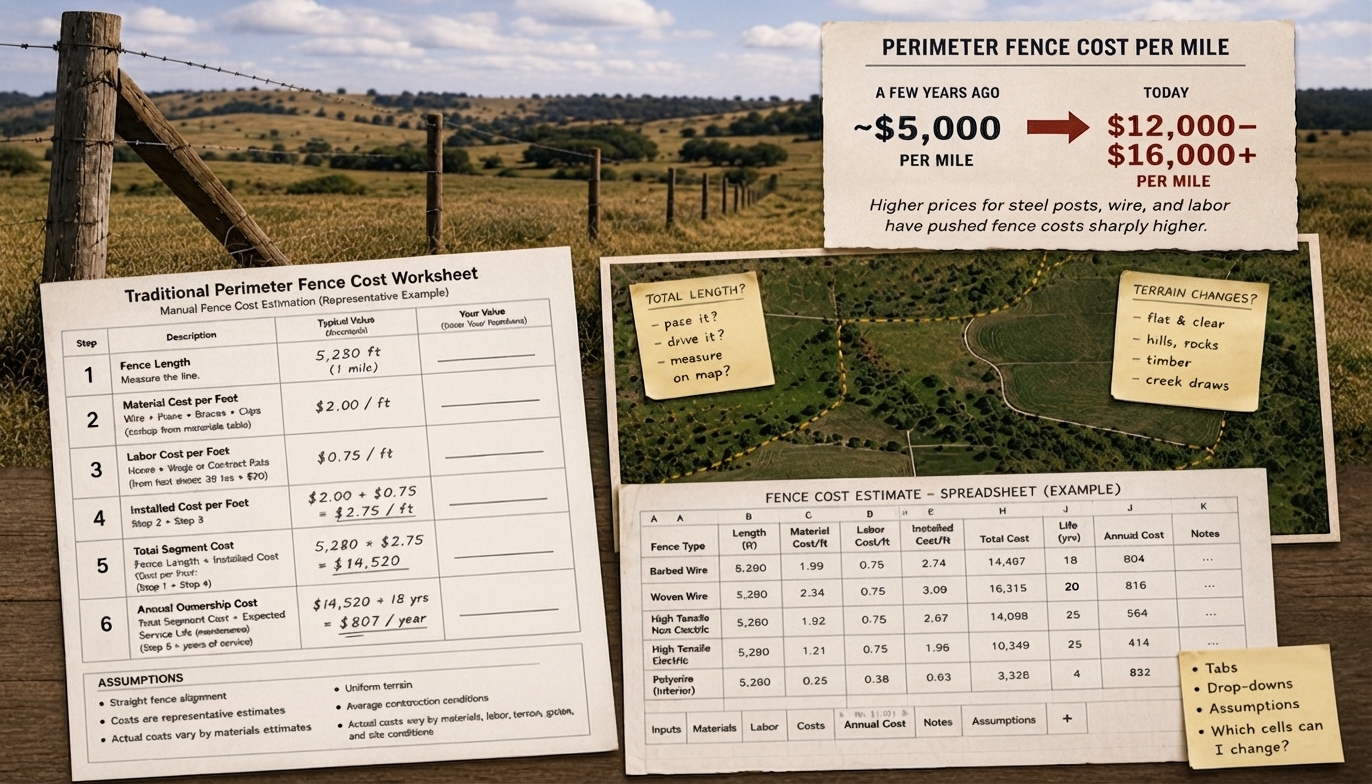
Figure 1. Extension’s traditional approach to fence cost estimation. Source: Based on concepts and specifications developed by the authors; rendered using OpenAI ChatGPT Image Generation.
How many feet of fence are you actually pricing? A producer has to pace it, drive it with an odometer, or measure it off a map. What does the ground do along the way, where is it flat and clear, where does it climb a grade, where does it push through timber that has to be cleared before a post goes in? Traditional worksheets and spreadsheets provide a useful way to estimate fencing costs, but incorporating differences in terrain and site conditions requires producers to collect and enter those measurements and assumptions manually. For long or varied fence lines, gathering and incorporating this information can be time-consuming.
Traditionally, extension offices would hand the producer a spreadsheet to help. These tools work, but they carry their own burden—often a separate fact sheet just to explain the inputs, or a half- or full-day workshop to learn how to navigate them. A producer faces rows of cells, drop-down menus, and assumptions buried in tabs, and is expected to know which numbers to change and which to leave alone. For someone who would rather be working cattle than wrestling a spreadsheet, that is often enough to set the whole thing aside, and the estimate never gets made at all.
This fact sheet introduces a different way. At https://cole.cowboyaiagent.org/cost_my_fence, an AI (artificial intelligence) agent lets you skip the spreadsheet entirely. You draw a line around your place on a provided satellite map, and the AI reads the ground beneath your fence line, including the land cover (grass, timber, brush, pond) and the slope, pulled from public satellite and elevation data.3,4 The AI then talks with you about what you want. Your interior fence lines will often be visible on the satellite image as well; trace those in as best you can and add new ones wherever you’re thinking about cross-fencing. From that reading, it lays out your exterior and interior fence in cost segments priced nearly post by post—about every 100 feet—so you can see exactly where the line runs cheap over open ground and where it climbs in cost through timber or up a grade. You change any number by saying it in plain words, and the cost updates on its own. No boxes to fill, no training class to attend.
How the AI tool reduces manual estimation steps. A spreadsheet is a blank set of boxes. It knows nothing about your ranch—you supply every number and it assumes flat, cleared, uniform ground because it cannot see otherwise. The AI tool reduces some of this manual work by using the producer’s drawn fence line together with available land-cover and elevation data to develop segment-level cost estimates. The job comes down to four simple stages, and the difference from a worksheet is readily apparent. everyone.
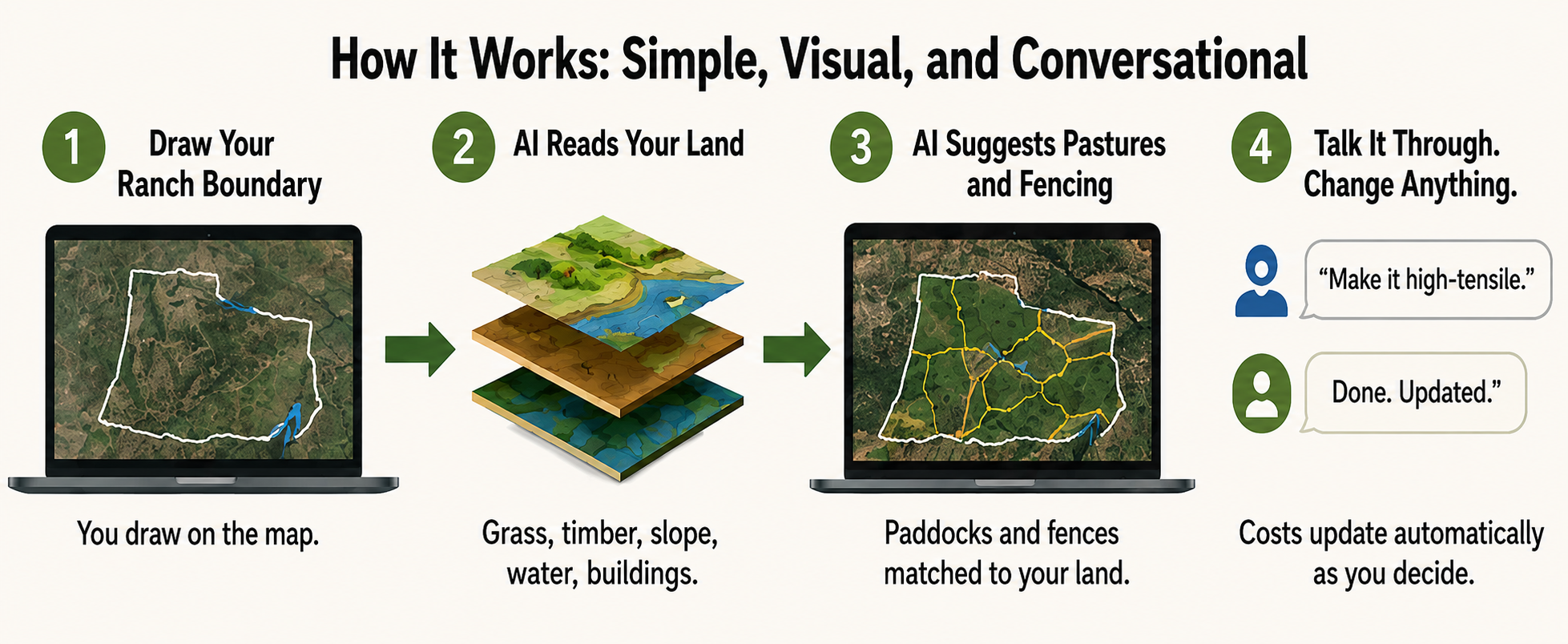
Figure 2. Overview of the AI agent approach to fence costing. Based on concepts and specifications developed by the authors; rendered using OpenAI ChatGPT Image Generation.
Draw your ranch boundary. A worksheet expects you to go measure or pace your fence line and key the total into the right cell which can be a real chore on a place with several miles of perimeter and interior fencing. The AI asks for one thing instead: trace your boundary and interior pastures on the satellite map. To get you there, just tell Cole where you are—the nearest town or a familiar landmark—and he’ll move the map to your ground. Most ranchers know their own boundaries by heart and fence lines are usually easy to pick out on the satellite image, so tracing your place is more a matter of recognizing it than measuring it. From that single drawn line the AI measures the mileage for you, down to the foot, with no pacing and no math. There is nothing to install and no program to learn—if a stretch is awkward, like the run along the creek, Cole walks you through each click. The spreadsheet can’t see the actual shape of your land and ground, but the AI does the moment the drawn line closes.
The AI reads your land. This is the judgment a worksheet leaves entirely to you: look up a cost per foot, then eyeball the terrain and pick a “factor” to bump it and hope you guessed right. Along your drawn line it pulls two kinds of public data (satellite imagery that shows the land cover (open grass, brush, timber, water) and elevation data that gives the slope of the ground) and reads your fence line the way an experienced hand would: where it runs easy over open pasture, where it pushes through timber that has to be cleared, where it climbs a grade that slows the work. It has read the land before you ask, and it will explain its reasoning whenever you want instead of burying the assumption in a cell on another tab. It then lays a color-coded, segment-by-segment overlay right on your fence lines and gathers the whole cost breakdown, including each segment’s terrain, slope, and dollars into a clear summary table you can read at a glance.
The AI suggests your fencing, segment by segment. The AI walks your boundary and groups it into honest cost-segments using the same kind of clustering math that powers modern AI data analysis, keeping each segment to one consistent type of ground and starting a new one wherever the land changes. A long prairie run becomes one segment, the wooded crossing another segment, and the rough grade another segment. Each is then priced on its own terms. Because the fence is broken out segment by segment, you can build your own scenarios—reroute a line, redraw a cross-fence, try a shorter run—and see each priced on the spot. Talk it through with Cole as you go and he’ll suggest where a different route might save you or where a stretch isn’t worth fencing at all.
Talk it through and change anything. On a spreadsheet you read a single total at the bottom and take it on faith. With the AI, every number stays yours to change just by saying so—“make it high-tensile,” “labor’s twenty an hour here”—and the cost updates as you decide. You can ask Cole, the AI agent, for his read “is high-tensile worth it over barbed on this ground?”, draw any other fence line you’d like priced, and get a segment-by-segment report that shows where each dollar comes from. The conversation stays open as long as you have questions. This is the same kind of plain-language ability behind tools like ChatGPT, but pointed at your fence, trained on fencing, and tied to your land. The spreadsheet handed you a number; the agent hands you an answer you understand and can keep working.
A walk through one ranch
Take a typical operation in southwest New Mexico—say 100 head on about 2,500 acres of mostly open rangeland northwest of Silver City, with piñon and juniper thickening in the draws and timber standing along the canyon bottoms, and a perimeter that runs close to 7.7 miles. The exterior fence is forty years old and starting to go in stretches; the producer knows a big replacement is coming but has no real idea what it will cost across ground that shifts from open grass to rocky, wooded slope. On top of that, they’ve long wondered whether cross-fencing for rotation would pay, but pacing several miles of interior fence line and pricing it by hand is exactly the chore that has kept the question unanswered for years. The rancher utilizes the AI tool and works with Cole, who handles the map and the land reading and talks through both exterior and interior fence decisions. Answers and figures appear together on a running summary—the Ranch Info panel—so nothing is hidden.
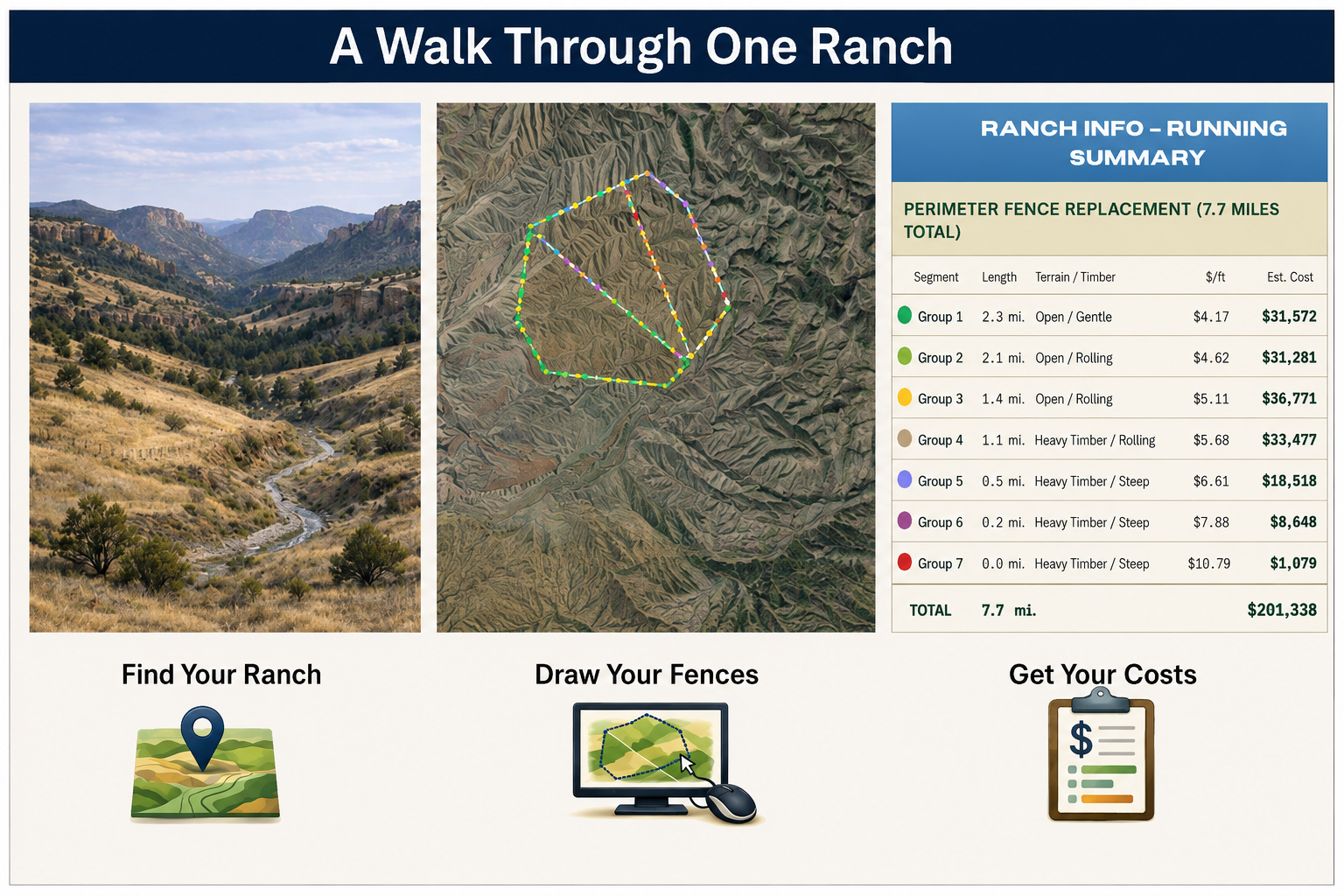
Figure 3. A typical fence cost estimate for a Southwest New Mexico ranch. Based on concepts and specifications developed by the authors; rendered using OpenAI ChatGPT Image Generation.
Sitting down and getting comfortable
Before any of that, it helps to know what kind of help you’re talking to. Cole isn’t a general-purpose chatbot; he has been trained by an AI specialist to be a fencing expert on the types of fencing and costs, how terrain and trees change the job, how to lay out paddocks, even the long history of fencing here in New Mexico from the open range to barbed wire to today. You don’t need to learn any special words or push the right buttons; you just talk to him the way you’d talk to an old hand leaning on the gate at the co-op. Curious whether high-tensile is worth it over barbed? Wondering how cross-fencing into a few more paddocks could stretch your grass through a dry summer? Ask. He’ll answer in natural plain language and then steer the conversation right back to your fence. The point is to make costing your fencing needs feel less like running a computer program, and more like having a conversation with someone who knows fence.
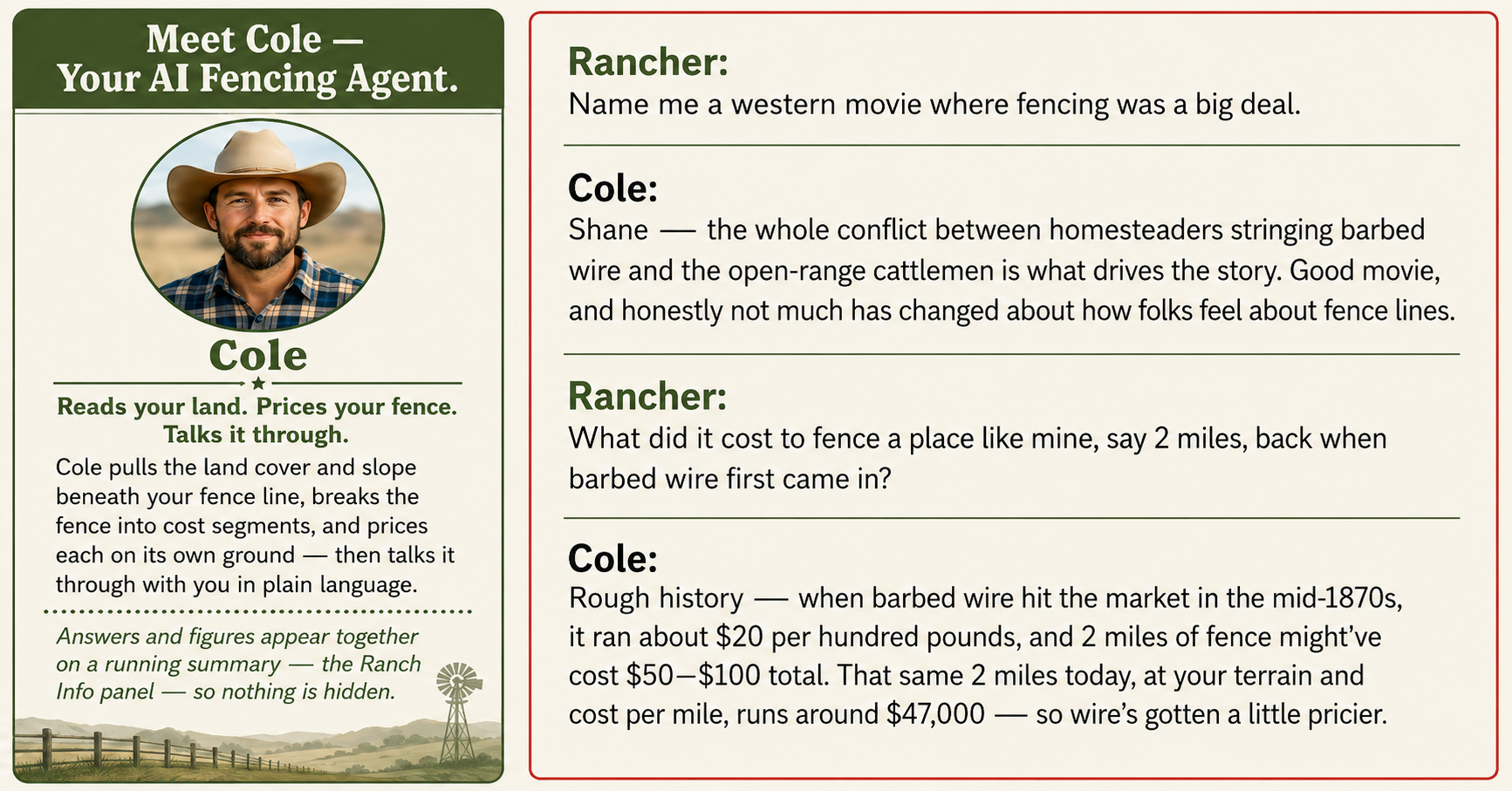
Figure 4. Talk to Cole, the AI agent, about all your fencing questions, even history. Based on concepts and specifications developed by the authors; rendered using OpenAI ChatGPT Image Generation.
First couple of steps— find ranch, then draw your perimeter
Now that you’ve met Cole, let’s get to work. The first thing Cole will do is help you find your ranch. Just tell him the county you’re in and what part, north, east, central—or better yet if you know your coordinates (Example 1). The satellite map will center on your ground, close enough to make out your fence lines, ponds, and tree lines. Once you’re looking at your place, click the drawing tool and trace your exterior perimeter as best you can, following your outside fence line corner to corner until the loop closes. Don’t worry about getting it perfect the first time, you can nudge any point afterward. When the boundary is drawn, press the Apply to model button and let Cole know you’ve finished. He’ll confirm that the perimeter geography has been read and will begin to work on it: measuring the miles, walking the line, and grouping it into segments by the ground beneath each stretch.
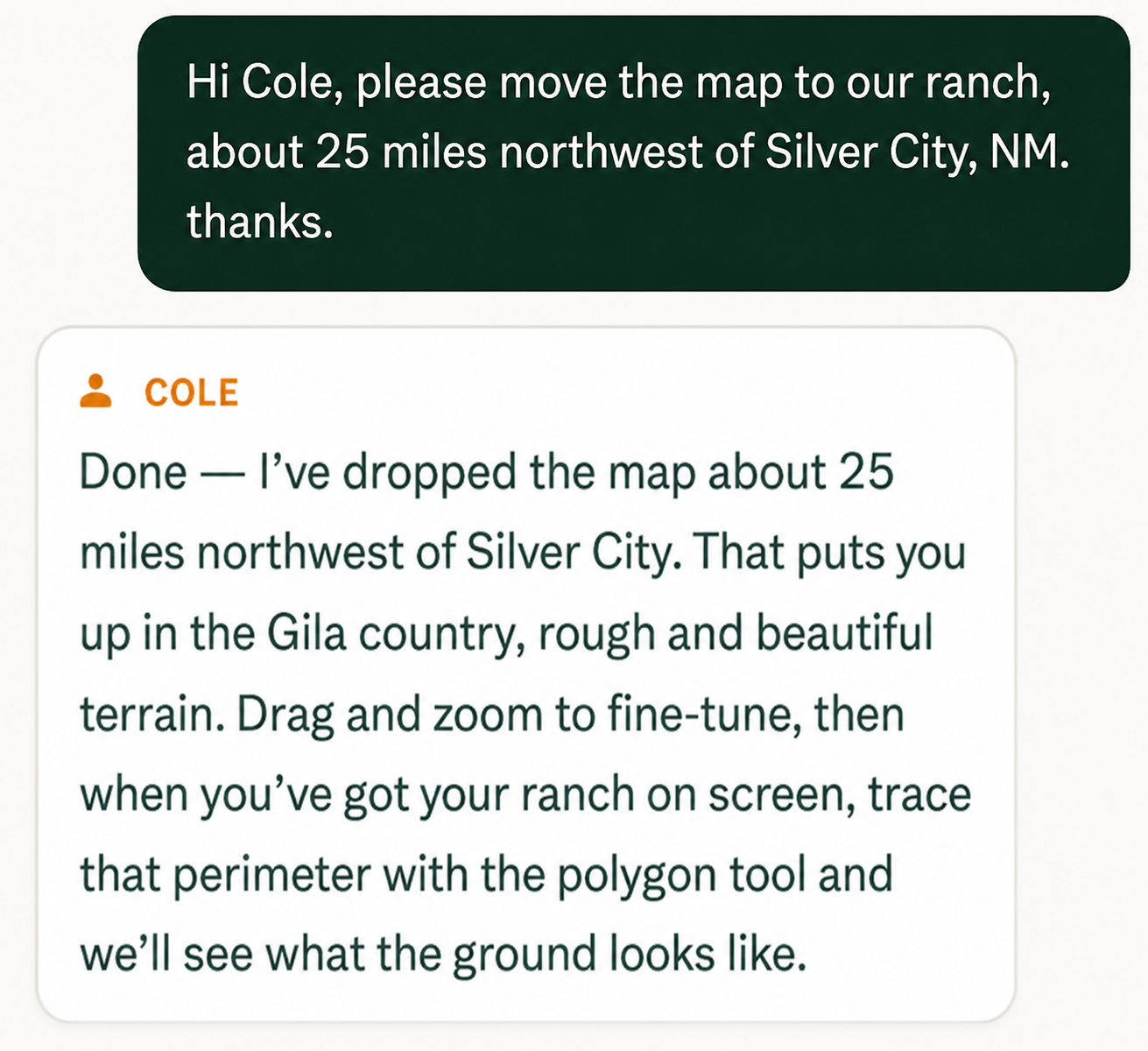
Example 1. User asking AI application to find the location of their ranch.
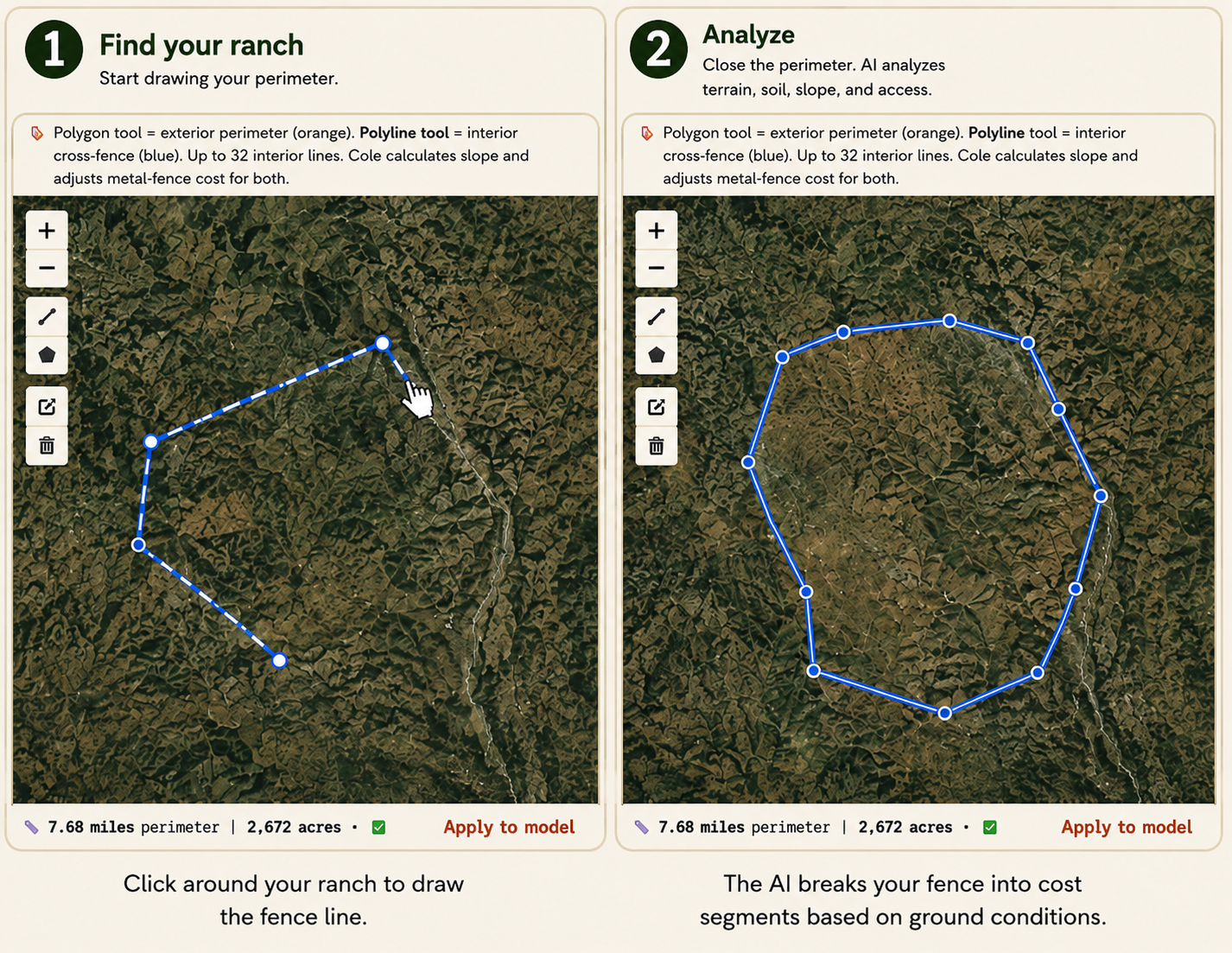
Figure 5. First couple of steps in costing your fence. Based on concepts and specifications developed by the authors; rendered using OpenAI ChatGPT Image Generation.
Third — Let Cole walk the line.
A moment later, your fence comes back color-coded on the map—each segment shaded by what it will take to rebuild. The open prairie runs show in one color, the heavy timber and steep ground in another, the creek-bottom stretches in another still. It’s the same fence you drew, but now you can see at a glance where the easy runs are, and where the timber and rough ground will run up your bill.
Alongside the map, the Ranch Info panel fills in the matching breakdown: each segment, its length, its terrain, the cost per foot, and what that stretch will run—a replacement estimate built from your ranch geography, not a flat guess. For a 7.7 mile perimeter like the one here, it might come back like this: a couple miles of open gentle ground at $4.17 a foot, then long runs of open rolling country where the price rises to $4.62 and $5.11 a foot, and finally shorter, steeper timbered sections that push the cost from $5.68 up past $10.70 a foot as the slope and trees thicken. Add it all up and the place comes in around $201,000 to refence—and every dollar of it traces back to a real stretch of your ground, not an average smeared across the whole line.
That’s the difference. The old worksheet would have handed you one number times 7.7 miles and called it done. Cole prices each stretch on the ground it actually crosses, so the estimate reflects the fence you’d actually build. If a segment looks off—too high, too low, or a rough stretch you know you’ll clear yourself—you don’t start over; you just click that piece of the fence to see exactly what’s driving its cost, or tell Cole what to change, and the whole estimate updates while you watch.
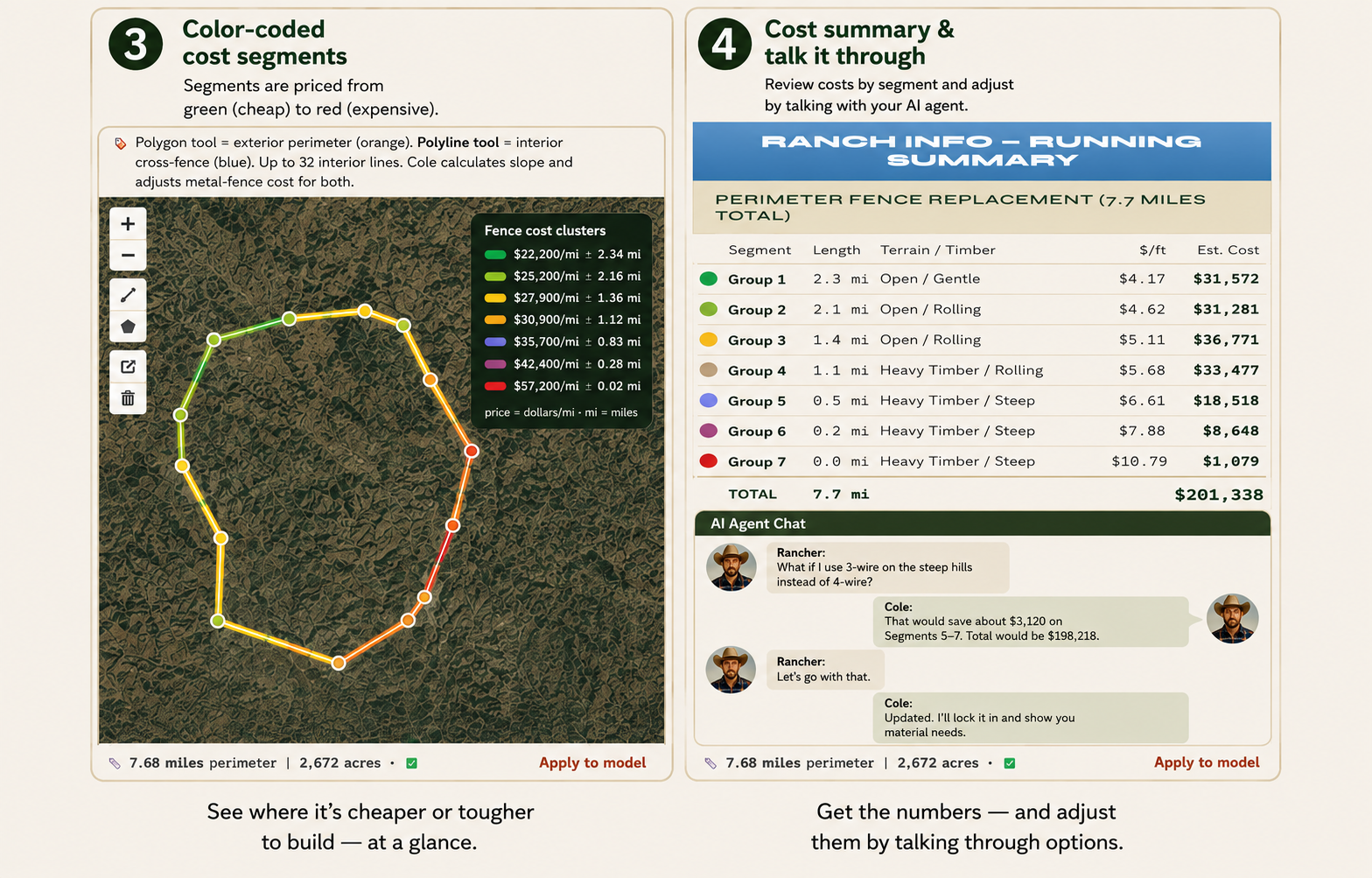
Figure 6. AI generated perimeter fence cost map and summary. The chat panel shows how producers can change assumptions and watch the estimate update in real time. Based on concepts and specifications developed by the authors; rendered using OpenAI ChatGPT Image Generation.
Fourth — Talk it through and make it your own
This is where the AI earns its keep. Your report comes back with the perimeter laid out in color-coded cost segments. Each stretch has its own rate and dollar figure, and Cole is right there to walk you through every single one. Nothing is hidden in a cell on another tab; you see exactly where each dollar comes from, and you can ask about any of it.
The real power is that every cost is yours to adjust on the fly just by talking. Start by asking Cole what he’s working from—“how many lines of barbed wire are you using, and what’s the labor rate?”—and he’ll lay it out: “Running 5 strands of barbed wire at $800 per strand-mile, and labor’s set at $20 an hour—130 hours per mile to put it in the ground.” Once you can see the assumptions, you can change any of them and watch the numbers move. Ask “how much would my fence cost change if labor was $15 an hour?” and Cole runs it: “At $15 instead of $20, your labor drops from $2,600 to $1,950 per mile—saving $650 a mile. Over your 7.7 miles that’s about $5,005 off, bringing you down to roughly $196,335. Want me to lock that in?” Or ask about the wire itself—“what if I went down to four strands instead of five?”—and he figures it: “Dropping to 4 strands saves $800 a mile in wire, knocking the base from $22,000 down to $21,200 a mile—about $6,100 off your capital cost over 7.68 miles (Example 2).” You are never stuck with a default you don’t believe. Change the post spacing, gates, the labor rate, the number of strands, the post type, and the estimate becomes your estimate.
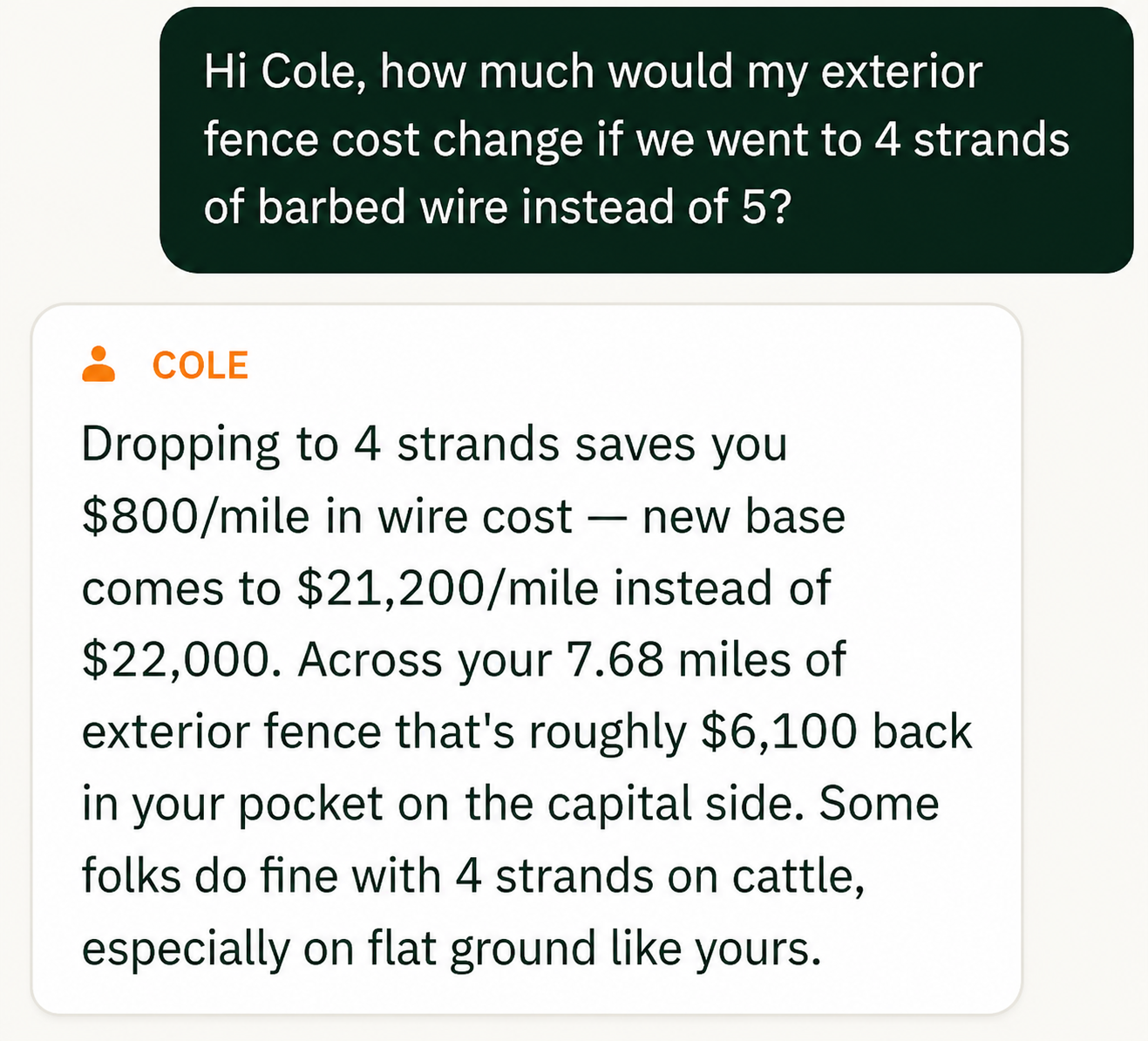
Example 2. User adjusting questions.
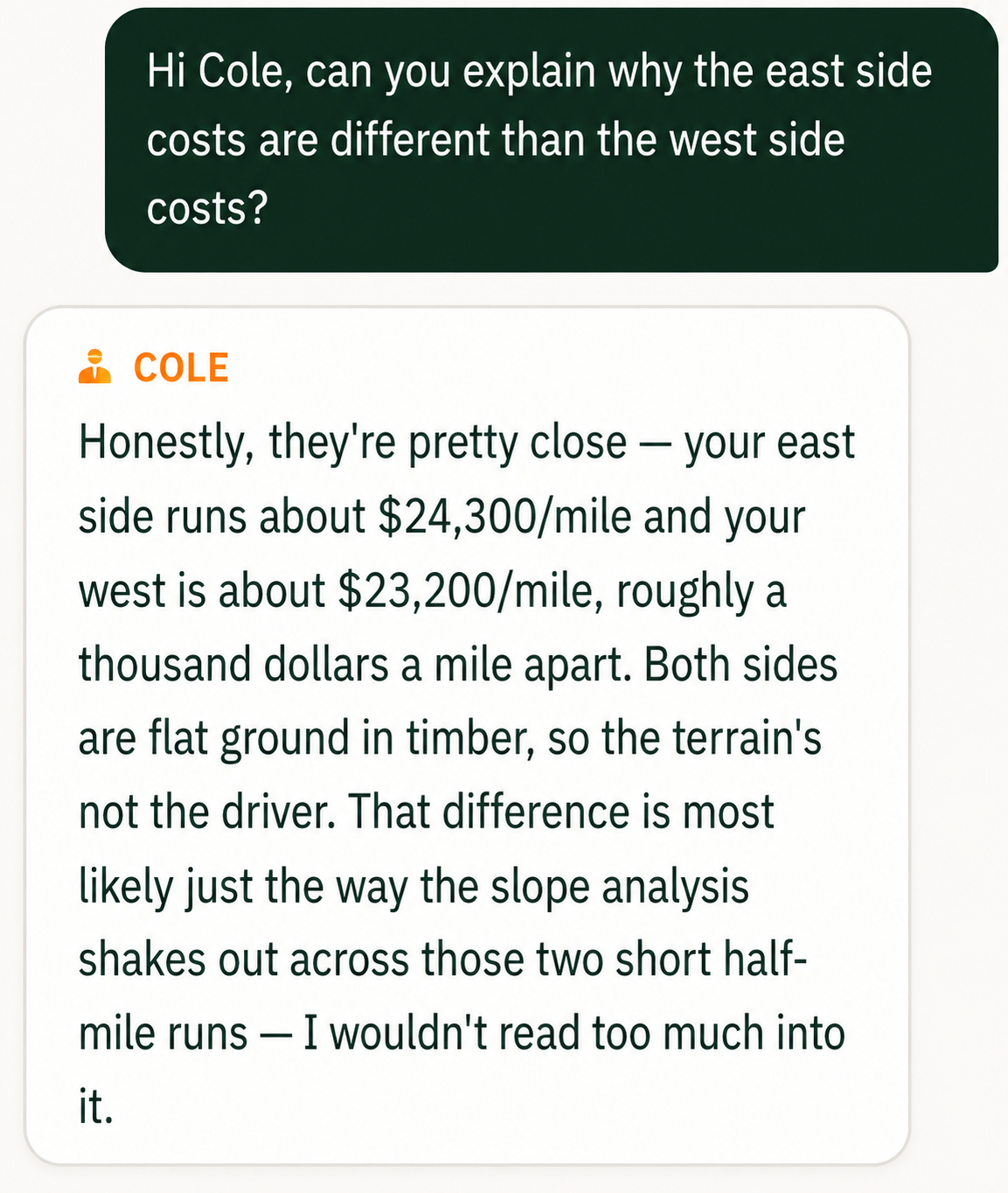
Haggle with Cole. Because you’re talking to Cole rather than reading a fixed printout, you can put him on the spot the way you would a contractor; ask him straight why one stretch costs more than another. “Why’s my east side different from the west?” He’ll pull what the map read and give it to you honestly: “They’re pretty close—east runs about $24,300 a mile, west about $23,200, roughly a thousand apart. Both sides are flat ground in timber, so terrain’s not the drive —I wouldn’t read too much into it (Example 3).” Users can ask Cole why estimated costs differ among fence segments and review the terrain and cost assumptions underlying those differences. Because AI-generated responses can contain errors, producers should verify important assumptions and estimates before making investment decisions. Tell Cole the supply store quoted you cheaper posts, or that his labor figure runs high for your part of the country, and he’ll work the number with you instead of holding a line. He’s not trying to pad the bid; he’ll tell you straight when a change saves you real money and when it barely moves the needle. What you end up with is a price you’ve dickered down to honestly, not one handed to you off a sheet. That alone goes a long way toward trusting the AI tool.
Interior fencing. Here’s an opportunity to weigh your options for the interior. In the example here, the ranch has 3 large pastures, requiring about 4.4 miles of cross-fence, broken into cost groups the same way the perimeter was—most of it running through timber on gentle ground, a couple of short stretches where it steepens, adding up to roughly $114,000 to build. Each stretch is priced on the actual ground it crosses, not a flat guess. From there, Cole can help you adjust the costs from the 5-wire barbed fence Cole gave you. Ask him which fence fits the job—high-tensile electric for rotation paddocks you may get a better cost, barbed-wire for long runs you want to last thirty years, braided wire where it’s just an everyday cross-fence. Cole will lay out the trade-offs, installed cost against lifespan, flexibility against permanence, and re-price the plan against whatever you choose. Ask him, “how much would my interior fence cost change if I switched to high-tensile 8-strand wire?” and he’ll run it for you—see the conversation in Example 4 for the quick comparison. High tensile non electric runs about $20,000 per mile on flat ground, a shade cheaper than your barbed wire interior. On your 4.4 miles of interior fence, that comes to roughly $87,600 versus about $92,856 for barbed wire—a savings of about $5,200 in capital cost. Continue the discussion with Cole as you refine the plan; he can help identify lower cost alternatives or materials that better match the job.
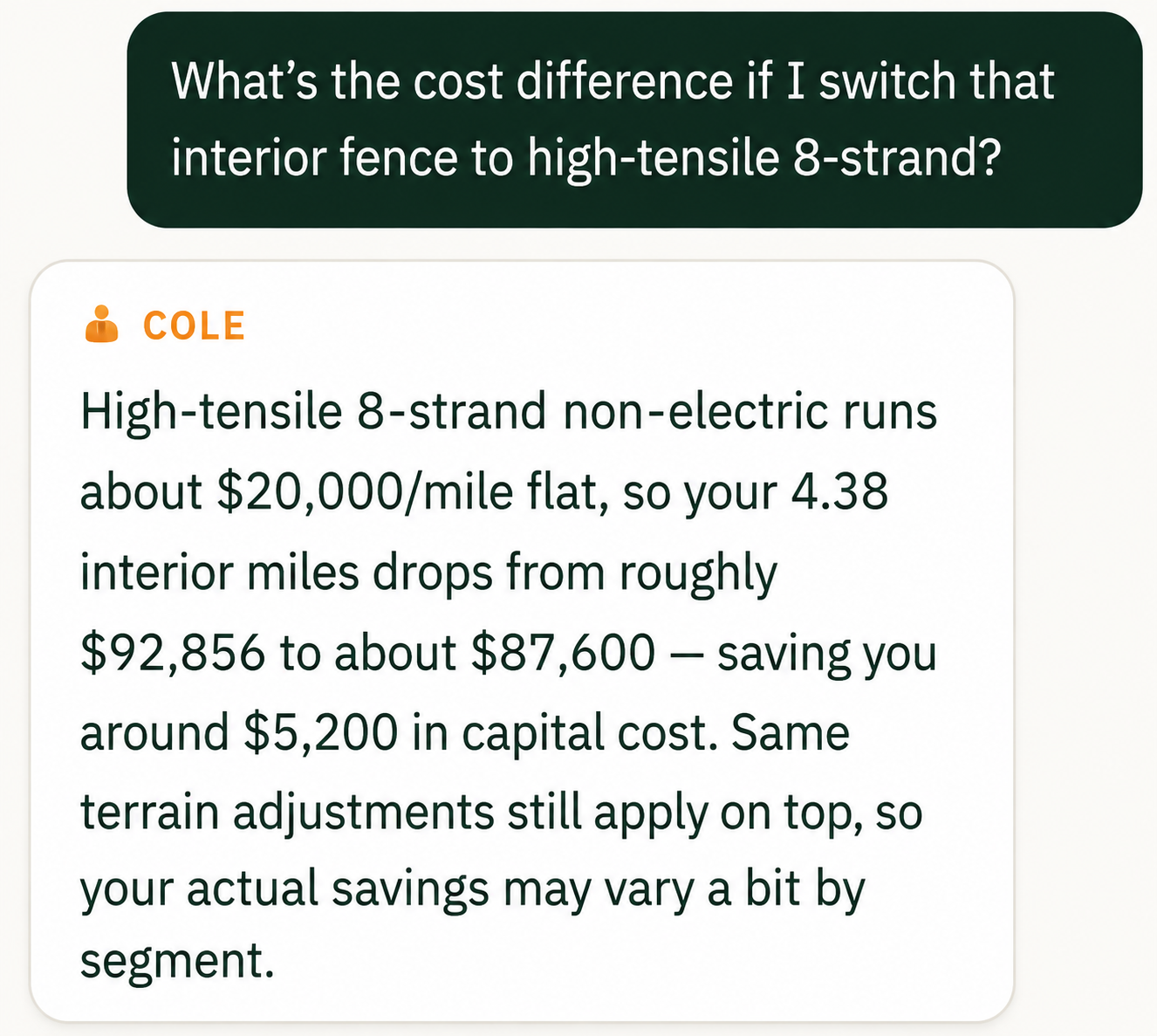
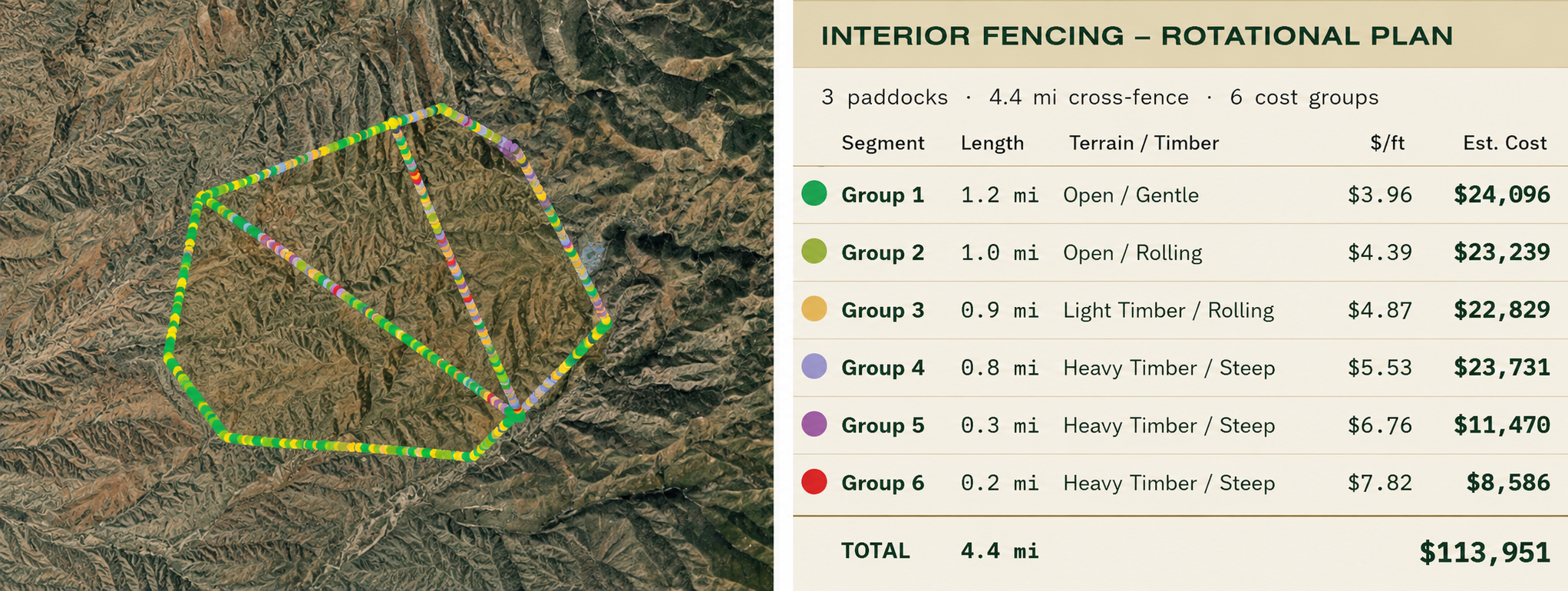
Figure 7. AI‑generated interior cross‑fence estimate for a three‑paddock rotation. The agent groups the 4.4‑mile plan into terrain‑based cost segments and prices each stretch according to the ground it crosses, with the table showing length, terrain, cost per foot, and total cost. Rendered using OpenAI ChatGPT Image Generation and author’s generated images from the AI app.
Final thoughts
One last thing is worth knowing, especially if you’ve heard the horror stories, Cole is not general-purpose chatbot like the ones in the news that confidently make things up. He has been built and trained specifically on fencing using advanced AI techniques—including a method called retrieval-augmented generation, or RAG, which means that before the agent answers, it looks up the facts from a trusted library of fencing and extension references and answers from those sources rather than from probability like commercial Gen AI. Costs, the materials, the terrain trade-offs, the extension research behind every figure, and his numbers come from published budgets and the data read off your own land, not from thin air. When Cole gives you a cost, it traces back to a real source you can check; when Cole recommends a fence, it’s grounded in the agronomy and the economics, not a guess. In plain terms: he stays in his lane. He knows fence, he sticks to what he knows, and this approach can improve the relevance and reliability of responses, but it does not eliminate the possibility of errors. Producers should review the underlying assumptions, update local costs where appropriate, and verify important estimates before making fencing decisions.
Try it
The tool is free at https://cole.cowboyaiagent.org/cost_my_fence. All you need is your ranch’s location—if you can find your place on a satellite map and draw a line around it, you can use it. No technical background required. Because some producers are cautious about digital tools and AI, the agent is designed to stay simple: you draw your boundary, say what you want, and it does the rest. A short YouTube video walkthrough is available if you prefer to see the steps demonstrated. It shows how to find your ranch, trace your fence lines, and read the cost results—a quick way to get comfortable before trying it yourself.
References
- Gifford, C., Utsumi, S., Ward, M., Vitale, P., Cox, A., Vitale, J., & Marta, S. (2025). Virtual fencing using e-collars on New Mexico cattle ranches [Guide B-132]. New Mexico State University Cooperative Extension Service. https://pubs.nmsu.edu/_b/B132/
- Drollette, R. (2024). Estimated Costs for Livestock Fencing [File B1-75]. Ag Decision Maker. Iowa State University Extension and Outreach. https://www.extension.iastate.edu/agdm/livestock/html/b1-75.html
- U.S. Department of Agriculture, National Agricultural Statistics Service. (2026). CropScape — Cropland Data Layer. https://www.nass.usda.gov/Research_and_Science/Cropland/SARS1a.php
- U.S. Geological Survey. (2026). 3D Elevation Program (3DEP). https://www.usgs.gov/3d-elevation-program
Developed using AI agentic methods. This is an exploratory decision-support tool meant to inform producer decisions, not to replace professional, site-specific, or contractor advice. Cost figures are public estimates at limited resolution and should be treated as starting points, not guarantees.

Pilja Vitale is an extension economist in the Cooperative Extension Service at New Mexico State University. She received her B.S. in Agricultural Economics from Seoul National University, an M.S. in Agricultural Economics from Texas A&M University, and a Ph.D. in Agricultural Economics from Oklahoma State University. Vitale worked with vegetable farmers in Oklahoma for about 20 years and her interest areas are crop and livestock budgets and production economics.
To find more resources for your business, home, or family, visit the College of Agricultural, Consumer and Environmental Sciences on the World Wide Web at pubs.nmsu.edu
Contents of publications may be freely reproduced for educational purposes. All other rights reserved. For permission to use publications for other purposes, contact pubs@nmsu.edu or the authors listed on the publication.
New Mexico State University is an equal opportunity/affirmative action employer and educator. NMSU and the U.S. Department of Agriculture cooperating.
September 2026 Las Cruces, NM